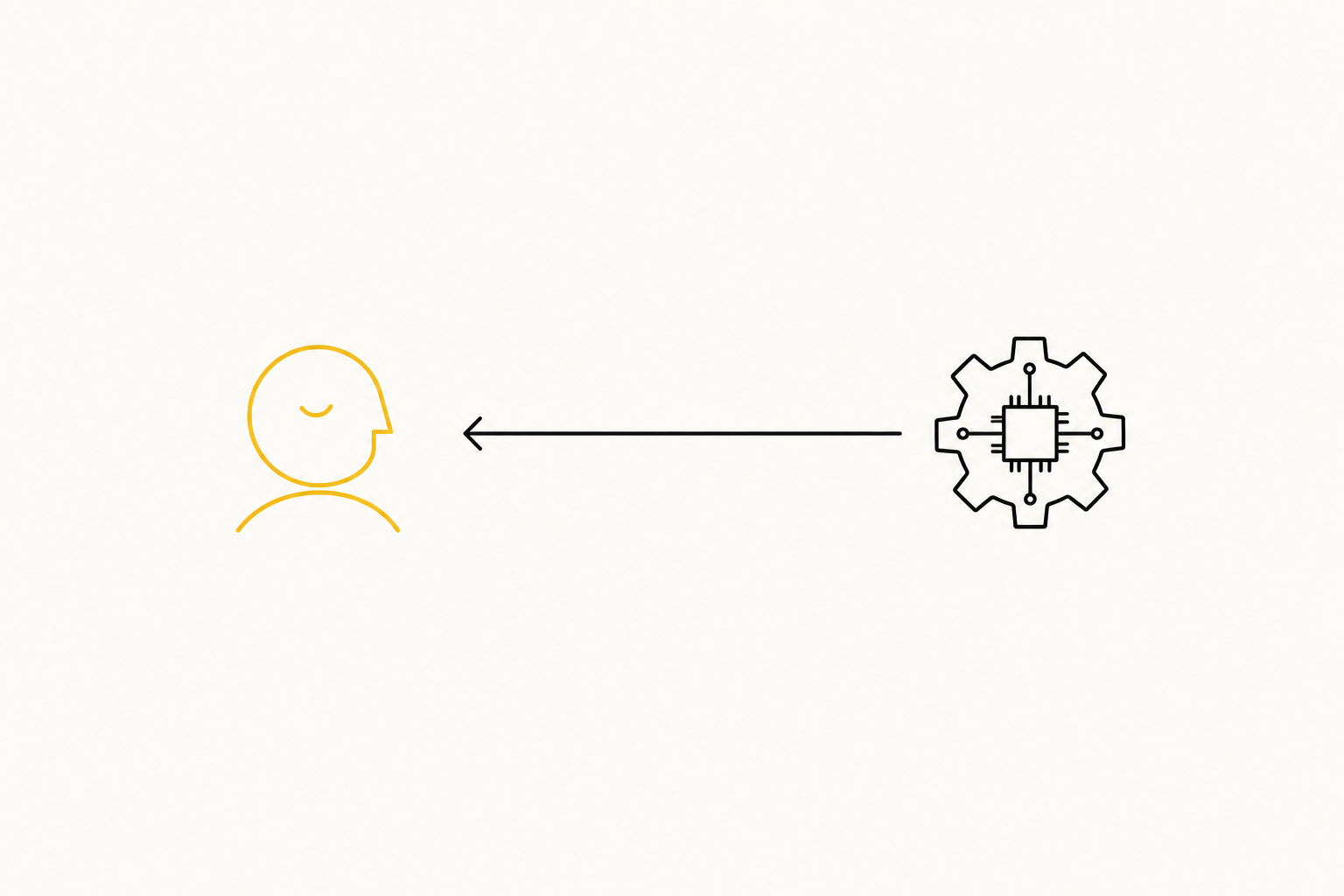
In 1997, on a conference stage, a famously exacting product leader answered a hostile question with a principle that outlived the argument: you have to start with the customer experience and work backwards to the technology — not the other way around. The design tradition he came to embody, echoing Dieter Rams a generation earlier, treats technology as something that should disappear behind an experience so clear it needs no manual.
Most enterprise AI is built the other way around. It starts with the model — "we have this capability, now where do we point it?" — and works forward to a use case. That is precisely how you get a stunning demo that nobody uses a month later.
Begin with the person, not the model
The first question is not "what can the model do?" It is "what is this person trying to accomplish, and what would make it effortless?" The salesperson does not want an AI. They want the quote done, correct, and out the door. The finance clerk does not want a chatbot. They want the overdue invoice handled without the dread. Design for that outcome and the model becomes an implementation detail — powerful, but subordinate to the experience.
Focus is saying no to a thousand things
The tradition's other half is focus. A product is defined as much by what it refuses to do as by what it does. An AI teammate that tries to do everything does nothing memorably well; it becomes a menu, not a colleague. Pick one workflow and make it feel effortless — genuinely, provably better than the manual way — before earning the right to the next. Restraint is not a limitation here. It is the strategy.
Sweat the details nobody notices — until they are wrong
Craft is the tradition's obsession, and in enterprise AI details are not polish; they are trust. The tone of a collections email. The rounding on a figure. The one edge case where the wrong currency slips through. A single wrong number in front of a customer quietly undoes a hundred correct ones. The work of getting these right — the guardrails, the checks, the human approval on the outputs that carry a person's name — is invisible when done well and catastrophic when skipped.
Simplicity is the hard part
Simplicity is not the absence of capability; it is the presence of judgment. Hiding the machinery — the connectors, the guardrails, the approval routing, the retries — behind an experience that feels like one calm action is enormous engineering. That concealed effort is the entire difference between a tool people tolerate because they were told to and one they reach for because it makes their day lighter.
Integration over assembly
The tradition's deepest conviction is that an experience is best when one hand designs the whole of it, end to end. For AI that means the trigger, the data, the model, the approval, and the delivery are designed together — not bolted together from parts that were never meant to meet. The seams between components are exactly where trust leaks out. A workflow that feels like a single, coherent thing is almost always one that was designed as a single, coherent thing.
Start with the experience. Say no until one thing is exceptional. Sweat the details. Hide the complexity. Design the whole, not the parts. The model will keep getting better on its own — that is the one part you can count on. The experience only gets better if someone insists on it.
References
- Walter Isaacson, Steve Jobs, Simon & Schuster, 2011.
- Dieter Rams, Ten Principles for Good Design, Vitsœ.
- Donald A. Norman, The Design of Everyday Things, revised ed., Basic Books, 2013.
- Ken Kocienda, Creative Selection: Inside Apple's Design Process During the Golden Age of Steve Jobs, St. Martin's Press, 2018.
Want to design your first AI workflow experience-first? Book a 30-minute call.