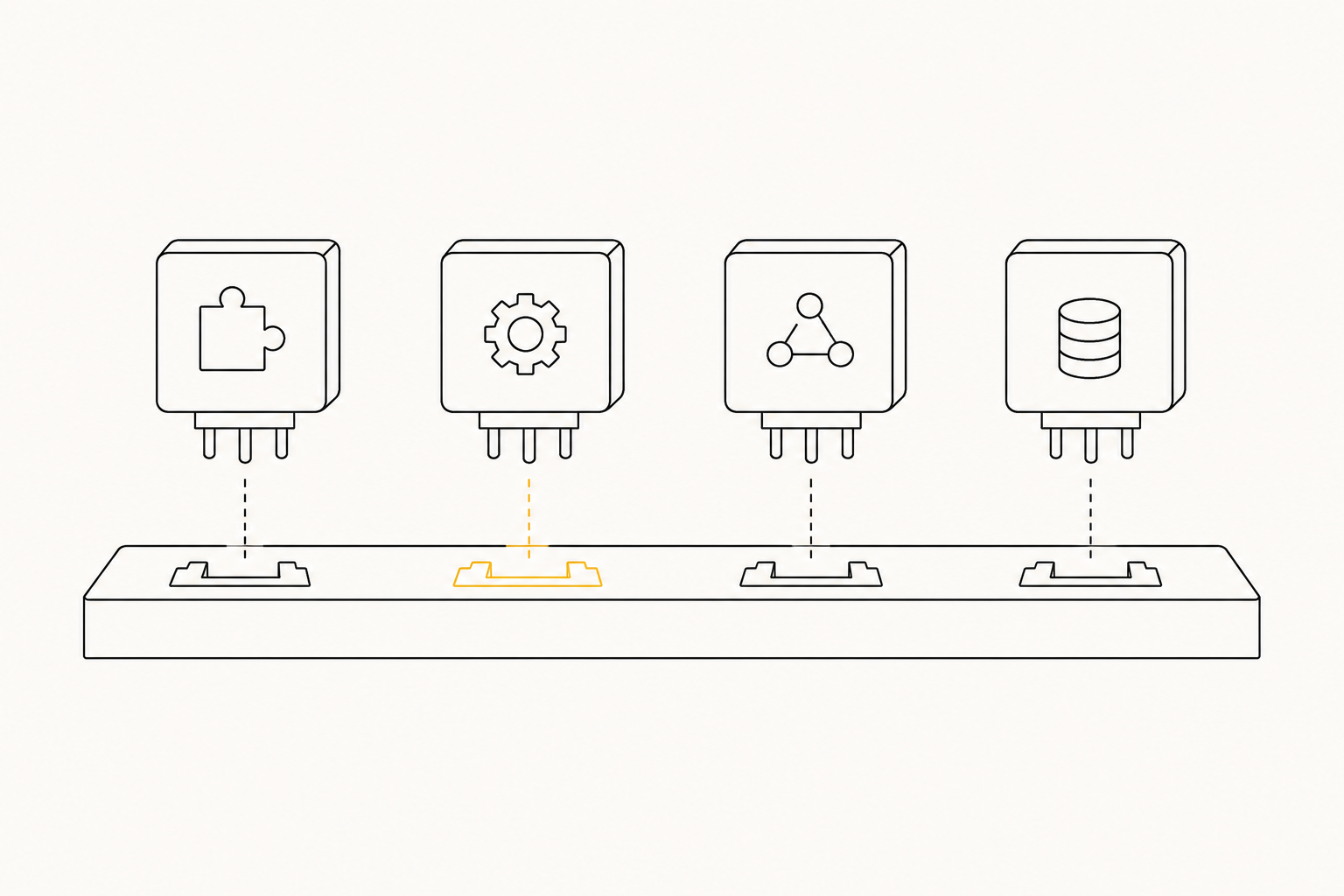
The software tradition that put a computer on a billion desks was built on one strategic bet, repeated for decades: do not ship a feature, ship a platform that others build on. Gawer and Cusumano called it platform leadership, and it explains more about durable software companies than any single product ever has. A feature solves one problem once. A platform lets thousands of problems get solved by people you will never meet.
Enterprise AI is at exactly the fork where that lesson decides who lasts. Most teams are shipping features. The ones that will still matter in five years are building platforms.
Features get replaced; platforms compound
An AI feature — "summarize this," "draft that" — is a commodity the moment a competitor ships the same button, which is usually next quarter. There is no defensibility in a capability everyone can rent from the same model providers.
A platform behaves differently. Connectors, reusable workflows, and extension points compound: every integration you add makes the next one cheaper and the whole system more valuable. That is a network effect, and it is the only kind of moat that gets deeper the more it is used.
The interface is the product
The hardest-won lesson of developer platforms is counterintuitive: the interface others build against matters more than the implementation behind it. For enterprise AI, the product is not the model — models are swappable and getting cheaper. The product is the connector layer and the workflow contract: the stable, documented surface that the ERP, the CRM, the inbox, and your own teams integrate with. Design those as first-class interfaces and the model underneath becomes an implementation detail you can upgrade at will.
Backward compatibility is a feature — the most expensive one
The tradition's near-religious discipline is refusing to break existing customers. It is unglamorous, it slows you down, and it is the reason software survives decades. The quote workflow that worked last week has to keep working this week, even after you have swapped the model, tuned the prompts, or added a new step.
This is precisely where AI systems betray you if you let them. Models change, providers deprecate, prompts drift — and without compatibility discipline, every upgrade silently breaks something in production. The remedy is boring and non-negotiable: version your workflows, pin behavior where it matters, test the old paths against the new model, and treat a breaking change as a deliberate, announced event — never an accident discovered by a customer.
Meet people where they already work
Platforms win by embedding into existing workflows rather than demanding new ones. Approvals should arrive in email, Slack, Teams, or the work board people already live in. Connectors should reach into the systems they already run. The best platform is the one that disappears into the tools people already have open — no new tab, no new habit, no migration project.
Extensibility without chaos: the governed platform
Open platforms rot without governance. Every extension point — every connector, every custom workflow — is also an attack surface and a cost center. So the extension model needs guardrails built in, not bolted on: scoped permissions, PII masking, per-workflow cost limits, and full tracing on every call. The art is an ecosystem open enough to compound and governed enough to trust in an enterprise.
The model is the commodity; the platform around it is the moat. Build the boring, durable interfaces — connectors, versioned workflows, compatibility guarantees — and let the value compound while everyone else re-ships the same feature.
References
- Annabelle Gawer and Michael A. Cusumano, Platform Leadership: How Intel, Microsoft, and Cisco Drive Industry Innovation, Harvard Business School Press, 2002.
- Marco Iansiti and Roy Levien, Strategy as Ecology, Harvard Business Review, March 2004.
- Michael A. Cusumano and Richard W. Selby, Microsoft Secrets, Free Press, 1995.
- Raymond Chen, The Old New Thing: Practical Development Throughout the Evolution of Windows, Addison-Wesley, 2006.
Want a look at whether your AI is a feature or a platform? Book a 30-minute technical review.