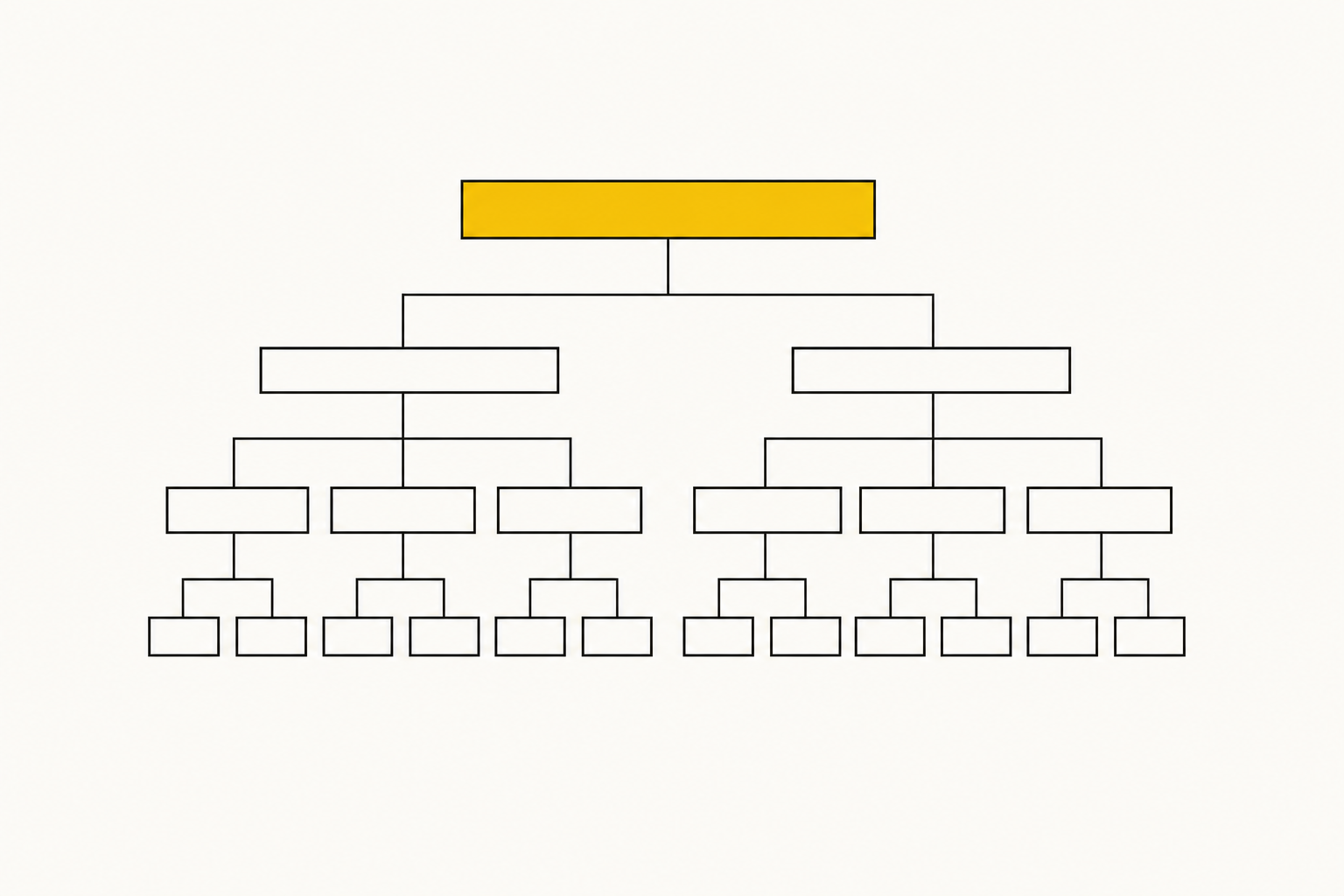
Here is the recommendation, stated before the argument for it: your AI teammate should be taught to communicate like a good consultant — answer first, tightly structured, and ruthlessly relevant. Everything below exists only to support that single claim.
That opening is not a stylistic tic. It is the whole point. In the profession that turned problem-solving into a craft, Barbara Minto codified the rule in The Pyramid Principle: readers absorb ideas most easily when they arrive top-down — the governing thought first, then the grouped arguments that support it, then the detail underneath. Decades later, most enterprise AI gets this exactly backwards, because models are trained to be comprehensive, not conclusive.
The governing thought comes first
Executives do not read to discover; they read to decide. A recommendation buried in the final paragraph has already failed, no matter how correct it is. Yet a language model's default habit is to narrate: set the scene, hedge, enumerate considerations, and — maybe — arrive at a conclusion at the end. A quote email that opens with three paragraphs of context buries the one number the customer opened it to find.
The fix is a rule, enforced in the workflow, not a hope: state the answer first, then support it. Recommendation, then reasons. The apex of the pyramid before its base.
MECE, or the support has to actually hold
Minto's second demand is that the supporting points be MECE — mutually exclusive, collectively exhaustive. No overlaps, no gaps. When an AI teammate justifies a decision — why this price, why this supplier, why this customer gets called today — the reasons should partition the problem cleanly.
MECE is also a quiet quality check on the model's own reasoning. If the supporting points overlap or leave an obvious hole, the recommendation resting on them is probably shaky. Structure is not decoration; it is a test the logic has to pass.
The "so what?" test
Consulting's most useful two words. Every paragraph, every figure, has to survive them. A data dump is not an answer. "Receivables are up 12%" — so what? "...so we should call these five accounts before noon." AI is extraordinarily good at producing the first half of that sentence and, by default, terrible at the second. The design job is to force the so what every single time — to convert an observation into a recommended action.
SCQA: giving the answer a frame
Minto's setup for the governing thought is Situation, Complication, Question, Answer. A collections message maps onto it perfectly: Situation (the invoice was sent), Complication (it is 30 days overdue), Question (implicit — now what?), Answer (the proposed next step). Structuring AI output this way makes it read like a decision brief rather than a status report, and it gives the human approver a frame they can scan in seconds.
What this looks like in production
Design each workflow's output as a pyramid: one recommendation at the apex, three or four MECE supporting points, evidence beneath. The payoff shows up at the approval gate. An approver who sees the answer first can decide in seconds instead of reconstructing the logic from a wall of prose. And because the structure is explicit, deviations are easy to catch — a missing so what, two reasons that overlap, a claim with no evidence under it.
The model supplies the intelligence. The pyramid supplies the discipline. Correct output is the floor; decision-ready output is the goal — and the difference between them is structure.
References
- Barbara Minto, The Pyramid Principle: Logic in Writing and Thinking, Pearson/FT Publishing, 2009 (orig. 1987).
- Ethan M. Rasiel, The McKinsey Way, McGraw-Hill, 1999.
- Chip Heath and Dan Heath, Made to Stick: Why Some Ideas Survive and Others Die, Random House, 2007.
- Gene Zelazny, Say It With Charts: The Executive's Guide to Visual Communication, McGraw-Hill, 2001.
Want your AI teammate's output to be decision-ready, not just correct? Book a 30-minute call.