Let me ask you a question that sounds simple but earned an economist a Nobel Prize: Why does your company exist?
Don't say "to make money" — that's the answer to what you do. The question is this: everything your company does, you could also buy from the market. Accounting from a firm, sales through commissioned agents, production from contract manufacturers. So why do you keep all those people inside — with salaries, benefits, and the overhead of managing them?
Ronald Coase asked this in 1937, and his answer eventually won him the Nobel: firms exist because using the market is expensive. For every task, you'd have to find a supplier, negotiate, write a contract, and monitor the result. Coase called these transaction costs. When they exceed the cost of coordinating the work internally, the firm grows. When the balance flips, it shrinks. The boundary of your company isn't drawn by your product — it's drawn by the price of coordination.
The thesis of this article is one sentence: AI is not a tool that automates your tasks; it is an event that reprices coordination. And when the price changes, every structure built on the old price — meaning your org chart — has to be recalculated.
Let's go layer by layer, starting from the foundation.
Layer 1: A company is architecture built around expensive information
A quarter century before Coase, in 1911, Frederick Taylor published The Principles of Scientific Management. Taylor is remembered today for timing workers with a stopwatch, but what he actually did ran deeper: he separated the knowledge inside the work from the person doing the work, and wrote it down. The craft in the foreman's head became, for the first time, an instruction, a standard, a report. Once knowledge became portable, it became manageable.
In 1916, Henri Fayol — a man who ran a mining company for thirty years, an owner-operator, not an academic — built the second floor on top of that: planning, organizing, coordinating, controlling. He wrote the job description for the profession we now call "management." And Max Weber, in the Germany of those same years, explained why bureaucracy was winning: files, hierarchies, and written rules are not arbitrary. They were the only way to process information reliably at scale with the technology of the day.
Put their shared discovery in today's language: management is an information technology. Every layer on your org chart is an answer to an information problem. How does the truth on the ground travel up? How does the decision at the top travel down? Who needs to know what, and who needs to approve what?
Middle management was invented for exactly this. A regional manager does, at its core, two jobs: compress information from below and carry it up; unpack decisions from above and distribute them down. We have paid salaries for this job for a century — because for a century, there was no other way to move, filter, and summarize information. A human was an expensive router, but the only router available.
Layer 2: From the typing pool to ERP — every time the price fell, the structure changed
This architecture never stood still. It was redrawn every time the price of information dropped.
The telephone carried the nuance the telegraph couldn't, and made the multi-branch company possible. The photocopier and the telex shifted the balance between headquarters and the field. When ERP systems arrived in the 1990s, "the guy who compiles the inventory report" became a query screen — and the management literature of that decade ran the exact same debate we're having now: delayering, flattening, "is middle management dead?" cover stories.
The pattern is always the same: as moving information got cheaper, the layers built to move it got thinner. But deciding, taking responsibility, and building trust never got cheaper. ERP showed you the inventory count instantly; it never showed you how much credit risk to extend to a customer.
That distinction — between transport and judgment — is the key to everything that follows. Hold onto it.
Layer 3: What AI actually changes
Now to the current evidence, because this is no longer theory — it's been measured.
Erik Brynjolfsson of Stanford, with Danielle Li and Lindsey Raymond of MIT, measured the effect of an AI assistant across a call center of more than five thousand customer-support agents (Generative AI at Work, 2023). Average productivity rose fourteen percent — but that's not the real finding. The real finding: the biggest jump came from the least experienced workers, at over thirty percent. Why? Because the AI took the tacit knowledge distilled from the best agents' conversations — the same craft knowledge Taylor chased with a stopwatch in 1911 — and whispered it into everyone's ear in real time. Experience became, for the first time, copyable.
The second study is even more instructive. Fabrizio Dell'Acqua and colleagues at Harvard ran an experiment with more than seven hundred BCG consultants (Navigating the Jagged Technological Frontier, 2023). Consultants using AI showed quality gains of up to forty percent on tasks the model was good at. But on tasks where the model looked competent and wasn't, AI users did worse than the control group — because they surrendered to the machine's confidence. The researchers call this the "jagged frontier": AI capability isn't a straight wall but an indented coastline. And the only way to map that coastline is by testing, measuring, and reviewing.
Put the two findings side by side and the picture is this: AI is driving the cost of moving and processing information toward zero — while raising the cost of deciding what to trust. Transport got cheap; judgment got expensive.
Now return to Coase's scale. If transaction costs draw the boundary of the firm, and one side of those costs is collapsing while the other is rising, then the boundary itself — and every layer inside it — will be redrawn. That's not a prediction. It's the arithmetic of Coase's own equation.
Monday morning, nine o'clock
Let's bring the theory down to one person's day. A scene from a distribution company we've spoken with — anonymized, but real.
The regional manager sits down at nine on Monday morning. Three windows are open: the sales export he pulled from the ERP, the WhatsApp messages six field reps sent over the weekend, and the weekly report template headquarters expects at three o'clock. The next five hours go like this: moving numbers from the export into the template, distilling a "here's what's happening in the field" summary out of scattered messages, calling to verify two line items that don't match last week's report. At three, the report goes out.
At three-thirty, the real work of the day lands on his desk: the region's biggest customer wants payment terms extended from sixty days to ninety. This is an actual decision — it requires knowing the customer, knowing the sector's cash crunch that quarter, and answering "is this customer bluffing, or genuinely in trouble?" with an instinct built over years. The manager gives this decision twenty minutes, at the most tired hour of his day.
So here's the question: which one earns that manager his salary — the five hours in the morning, or the twenty minutes in the afternoon? Everyone knows the answer: the twenty minutes. But the architecture of his day says the opposite. The salary is paid for judgment; the hours go to transport. Inside that one box on the org chart, two different jobs — one valuable, one newly cheap — sit crammed into the same person's day. The real promise of AI is not to delete that box. It's to hand the five hours to a machine and move the twenty minutes to the best hour of the day.
Layer 4: The question flips
In 1937, Coase asked: "If the market exists, why does the firm?"
In 2026, the question every owner should ask is its mirror image: "If AI exists, why does this layer of my company?"
I can hear the objection from anyone who has read their Coase carefully: "If coordination is getting cheaper, firms should shrink and buy everything from the market — yet the largest companies in history are the ones holding this technology. Did the theory just break?" No — and the answer to this objection is the finest point in this article. AI doesn't only lower the cost of buying from the market; it lowers the cost of internal coordination at least as much, probably more. A market transaction still requires contracts, trust, and monitoring — those are judgment work, and judgment is the side getting more expensive. Internal coordination is mostly transport — and transport is the side collapsing. Both pans of Coase's scale are getting lighter, but the internal pan is getting lighter faster. The result: the firm's boundary isn't collapsing inward; its internal layers are collapsing into themselves. The company doesn't disappear. It gets thinner. The theory didn't break — it's doing exactly what it said it would.
And note — the flipped question is not "who do I lay off?" That is the most dangerous of the wrong questions. The right question, for each layer, one at a time, is: does this layer move information, or does it decide?
- The person who compiles the weekly sales report is moving information. That work can be handed to a workflow — and once it is, that person starts doing the work they never had time for: understanding why the numbers look the way they do.
- The person deciding whether to extend credit terms to a risky customer is exercising judgment. That work cannot be handed off; the jagged frontier makes it more valuable than ever. But assembling the file that lands in front of that decision — payment history, sector risk, open balance — is transport, and it should arrive in seconds.
The practice of this is not romantic; it's engineering: which output requires whose sign-off, below which threshold things auto-complete, how every decision gets recorded. Whatever Weber's bureaucracy was — written rules against arbitrariness, memory, accountability — approval gates, guardrails, and traces are the same thing for the AI era. Bureaucracy didn't die. It dropped to milliseconds.
The owner's three questions
If you keep one thing from this article, keep these three questions. Next week, put your org chart on the table and ask them of every box:
- What share of this box's time goes to moving information (compiling, summarizing, forwarding, formatting), and what share to deciding? If transport is above fifty percent, that box isn't AI's problem — it's yours. You're paying an expensive human to do work that just got cheap.
- Is there a record of the decisions this box makes? Who approved what, based on what information, and why? Without that record, you can't teach a machine — or a new hire — what a good decision looks like when you delegate.
- If this box disappeared, what would you lose — information or trust? Information can be substituted. Trust — the customer's voice, the supplier relationship, the team's morale — cannot; that box is probably the most valuable asset on your chart, and AI isn't its rival. It's the lever that buys it time.
The fossil and the living thing
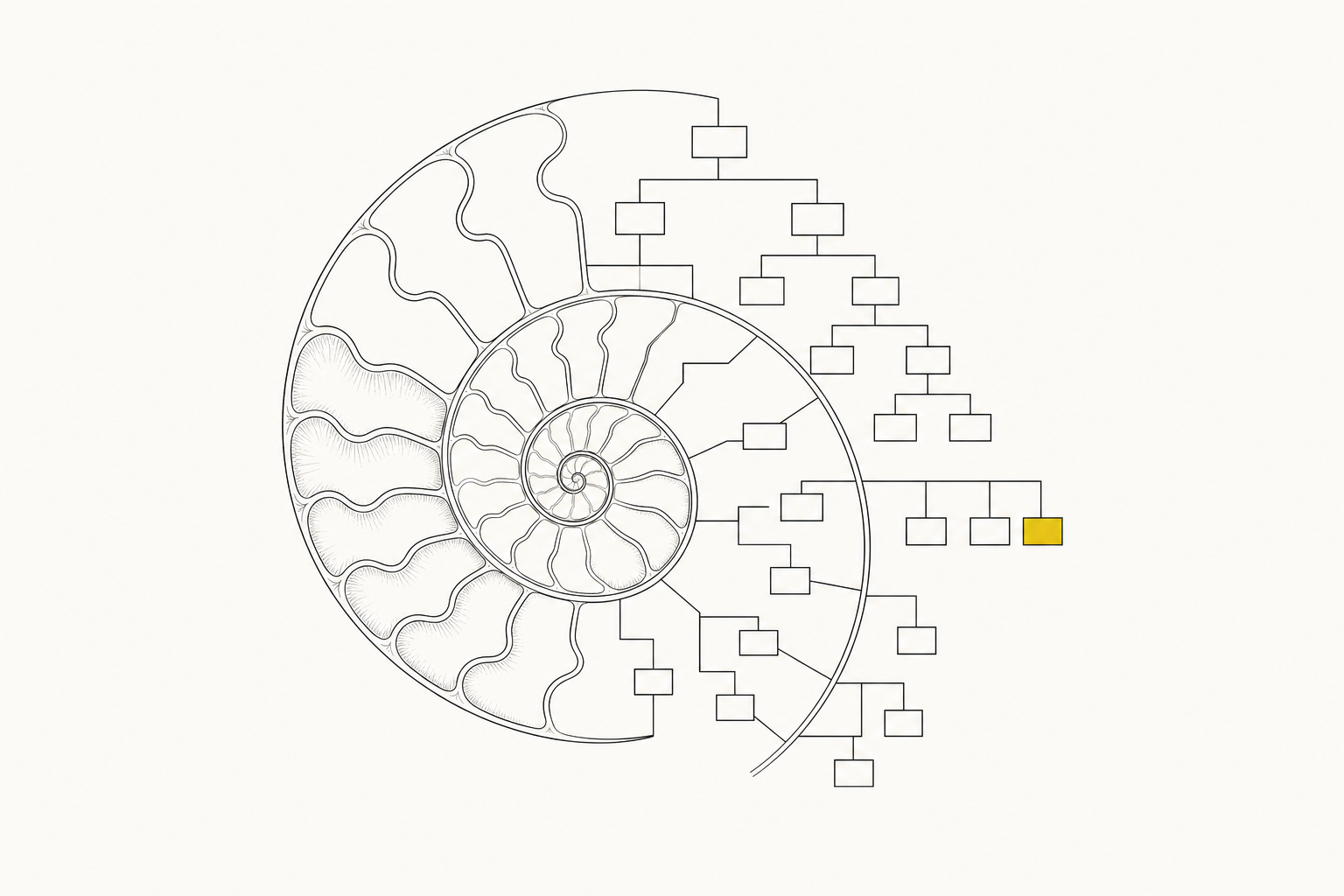
Your org chart is a fossil of the information prices that existed on the day your company was founded. There's no shame in that — everyone's is. Being a fossil means having once been perfectly rational.
The problem is defending the fossil after the prices have changed. Companies that answer 2026's question with 1911's answer will bolt AI on top of their existing layers as one more layer — and their pilots, like the ones before, will stay in the storage room. The companies that ask Coase's question again will come out of this era not with fewer layers, but with the right layers: an architecture where transport belongs to machines, judgment belongs to humans, and the record belongs to the system.
Firms exist because they're cheaper than the market. That's still true. The only thing that changed is the definition of "cheap" — and that definition is being rewritten right now, faster than at any point in a hundred years.
References
- Ronald H. Coase, "The Nature of the Firm," Economica, 1937.
- Frederick W. Taylor, The Principles of Scientific Management, 1911.
- Henri Fayol, Administration industrielle et générale, 1916.
- Max Weber, Wirtschaft und Gesellschaft (theory of bureaucracy), 1922.
- Erik Brynjolfsson, Danielle Li, Lindsey R. Raymond, "Generative AI at Work," NBER Working Paper 31161, 2023.
- Fabrizio Dell'Acqua et al., "Navigating the Jagged Technological Frontier," Harvard Business School Working Paper 24-013, 2023.
Want to try separating transport from judgment in your first workflow? Book a 30-minute call and we'll work through your org chart together.