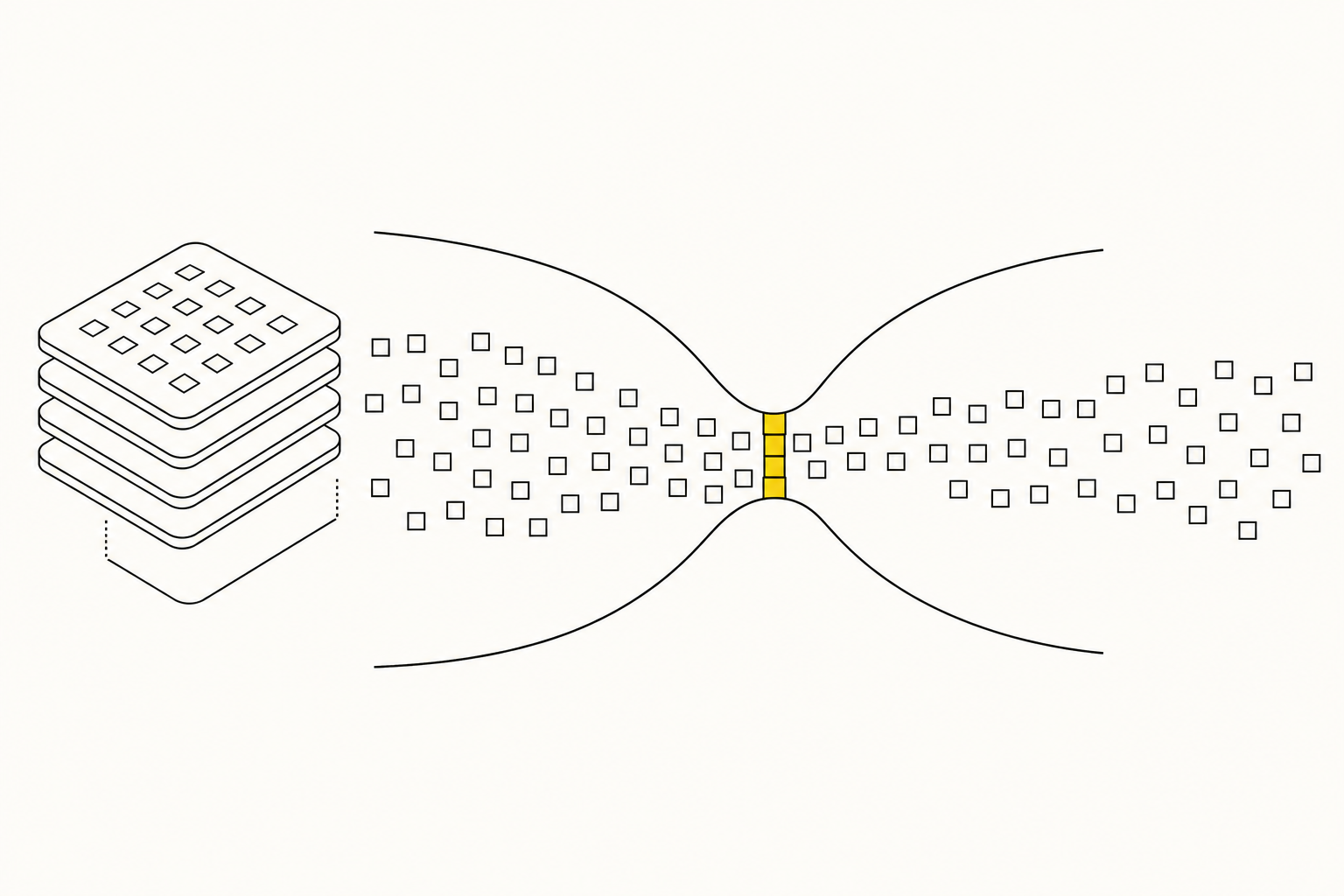
Read enough of Harvard Business Review over enough years and you notice it keeps circling the same three ideas from different angles: what an organization knows, where its work gets stuck, and how it spends its scarcest resource, time. We tend to treat these as separate management topics — knowledge management here, process improvement there, productivity somewhere else. They are not separate. They are three views of one system, and enterprise AI only pays off when you see them together.
The bottleneck is where the work waits
Start with the most physical of the three. Every process has a constraint — a single step where work piles up and everything downstream waits. Speed up any other step and nothing changes; the queue just moves. This is the intuition behind decades of operations thinking, and Michael Hammer sharpened it for the information age in his 1990 HBR classic, Reengineering Work: Don't Automate, Obliterate. His warning still lands: if you automate a broken process, you get a faster broken process.
In most companies the real bottleneck is not a machine or a missing tool. It is a handoff — the quote that waits for someone to gather margin data, the invoice follow-up that waits for someone to check the ledger, the report that waits for someone to assemble numbers from five systems. The work is not hard. It is waiting on a person who holds context nobody else has.
The context nobody else has is organizational memory
That phrase — context nobody else has — is the second idea. Ikujiro Nonaka named it in The Knowledge-Creating Company (HBR, 1991): the most valuable knowledge in a firm is tacit. It lives in people's heads, in how the veteran salesperson prices a tricky deal or how the AR clerk knows which customer to call gently and which to press. It is rarely written down, and when that person is on vacation, the bottleneck gets worse.
Hansen, Nohria, and Tierney turned this into a strategic choice in What's Your Strategy for Managing Knowledge? (HBR, 1999). They contrasted codification — writing knowledge down so it can be reused — with personalization — connecting people so tacit knowledge flows in conversation. Most enterprises accidentally over-index on personalization: knowledge stays in heads, never gets codified, and every process quietly depends on a few people remembering how things work. That undocumented dependence is the bottleneck. Organizational memory and the constraint are the same problem wearing two labels.
Busy is not productive
The third idea reframes what we are even optimizing. In Beware the Busy Manager (HBR, 2002), Heike Bruch and Sumantra Ghoshal found that only about 10% of managers spend their time in a purposeful, focused way — the rest are busy but not effective, mistaking motion for progress. Michael Mankins and colleagues quantified the organizational version in Your Scarcest Resource (HBR, 2014): companies guard their capital budgets ferociously while letting their scarcest resource, time, leak away in low-value coordination.
Put the three together and the picture is uncomfortable. Enterprises feel productive because everyone is busy. But much of that busyness is people acting as the human glue across handoffs — gathering, chasing, assembling, remembering — precisely because the organizational memory was never codified and the bottleneck was never removed. The activity is real. The productivity is not.
Where AI actually fits — and where it doesn't
This is why "add AI" so often disappoints, and why occasionally it transforms. Heed Hammer's warning first: point AI at a broken process and you have automated the mess. But used against the right target, AI does something the earlier HBR authors could only wish for — it makes tacit knowledge operational.
An AI teammate embedded in a workflow is, in effect, codified organizational memory that can act. When it drafts the quote, it applies the margin logic the veteran used to hold in her head. When it chases the invoice, it encodes which customers get a gentle tone. Every human approval and every edit is captured — turning tacit judgment into an explicit, reusable pattern. That is Nonaka's tacit-to-explicit conversion, finally with an execution engine attached.
Crucially, this attacks all three problems at once:
- It relieves the bottleneck by doing the waiting-on-a-person work in minutes instead of hours.
- It preserves organizational memory by codifying judgment that used to walk out the door at 5 p.m. or leave with an employee.
- It reclaims time by pulling people out of the human-glue role and back into the purposeful work Bruch and Ghoshal found so rare.
The holistic takeaway
The mistake is to run three separate initiatives — a knowledge-management project, a process-improvement project, an AI project — that never talk to each other. The HBR canon, read holistically, says they are one initiative. Find the bottleneck. Notice that it is almost always undocumented organizational memory. Codify that memory into a workflow an AI teammate can execute, with a human owner approving and correcting. Measure the result not in "activity" but in time returned to work that matters.
Do that and productivity stops being the thing you can't see. It becomes the thing you can measure — one workflow at a time.
References
- Michael Hammer, Reengineering Work: Don't Automate, Obliterate, Harvard Business Review, July–August 1990.
- Ikujiro Nonaka, The Knowledge-Creating Company, Harvard Business Review, November–December 1991.
- Morten T. Hansen, Nitin Nohria, and Thomas Tierney, What's Your Strategy for Managing Knowledge?, Harvard Business Review, March–April 1999.
- Heike Bruch and Sumantra Ghoshal, Beware the Busy Manager, Harvard Business Review, February 2002.
- Michael C. Mankins, Chris Brahm, and Gregory Caimi, Your Scarcest Resource, Harvard Business Review, May 2014.
Want to find the bottleneck hiding in your organizational memory? Book a 30-minute call and we'll map it together.