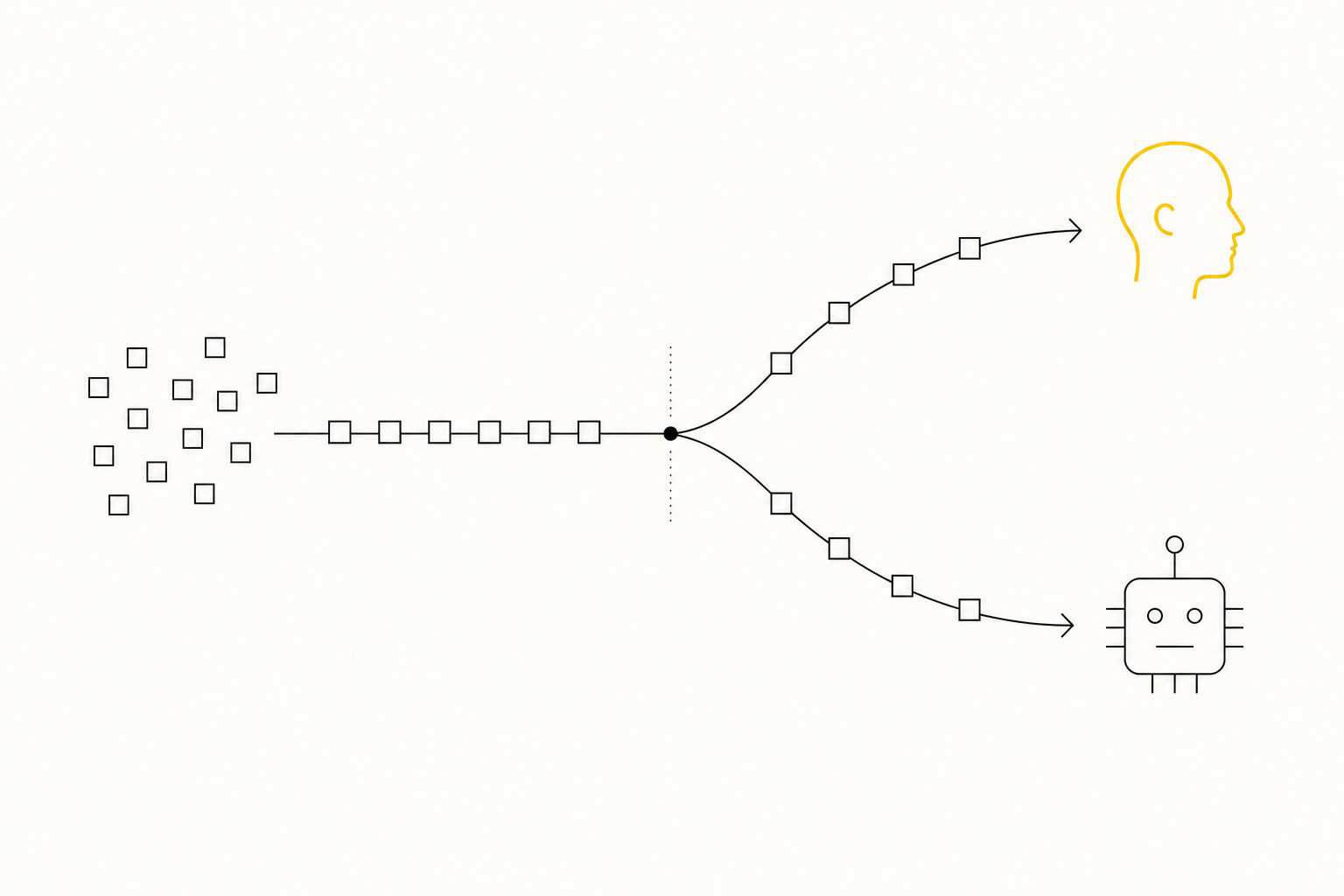
When you evaluate an AI teammate, the competing line in your budget is rarely another piece of software. It is a person. The question in the room is "do we hire one more, or do we deploy this?" — and most people answer it with the wrong kind of math.
The wrong math is absolute: which one is faster, which one is cheaper per task? David Ricardo showed in 1817 why that framing misleads. His theory of comparative advantage proved that even when one party is absolutely better at everything, total output still rises when each specializes in what they are relatively best at. The right question is never "who is better?" It is "what is the opportunity cost of each hour?"
The true cost of a new hire
Start with the honest number, because the sticker salary is the smallest part of it. A new hire costs you:
- Salary and burden — base pay plus benefits, tax, equipment, and overhead, typically well above the headline figure.
- Time to fill — weeks of an open role while the work piles up or gets dropped. Industry surveys put average time-to-fill at well over a month.
- Ramp-up — the months before a new employee is fully productive, during which they consume a manager's attention and produce below capacity.
- Turnover risk — a meaningful share of hires leave within the first year, and if this one does, you pay the search, ramp, and lost-productivity cost all over again.
What an AI teammate actually takes over
Now the other side. An AI teammate does not take over a person's job. It takes over the slices of the job with no comparative advantage for a human — the three hours of data gathering, margin calculation, and PDF formatting that sit in front of a thirty-second decision. It is very good at the repetitive, structured, high-volume work and, under an approval gate, it does that work without needing the salary, the ramp, or the search.
What it does not take over is the part where a human has genuine comparative advantage: the judgment on the edge case, the relationship with the customer who is about to churn, the negotiation, the call that needs someone accountable behind it. No model replaces that, and you would not want it to.
Comparative advantage: the right question
Here is Ricardo applied to your operation. Your best salesperson might, in absolute terms, format a quote faster than a junior would. That does not mean they should. Every hour they spend formatting quotes is an hour not spent on the relationship that closes the deal — and the relationship is where their comparative advantage is enormous and a model's is near zero. Moving the formatting to an AI teammate is not about the teammate being "better" at formatting. It is about freeing the scarce, high-opportunity-cost hour for the work only that person can do.
This is why the framing matters so much. Read as replacement math, AI looks like a way to cut heads. Read as comparative-advantage math — which is the economically correct reading — it is a way to raise the output of the people you already have, by pulling them off the work where they have no edge.
Capacity, not headcount
So the real decision is not "AI or a hire." It is "do I need more capacity, and what is the cheapest honest way to get it?" For a large, recurring, structured workload, an AI teammate adds capacity without adding a salary, a ramp, or turnover risk — and it does so on the timeline of a deployment rather than a hiring cycle. When the work is genuinely relational, judgment-heavy, or accountable, you hire, because that is where the human edge lives. Most operations need some of both. The mistake is buying a full-time head to do work that has no comparative advantage for a human — and then wondering why that person is disengaged three months in.
"If a three-hour task now takes twenty minutes, what is that person doing with the rest of the day?" That is the question that decides whether this was a good decision. The right answer is: the work you actually hired them for.
Conclusion
Ricardo answered this in 1817. The question is not "which is better, the human or the AI?" It is "what is the opportunity cost of every hour?" An AI teammate is not a smaller, cheaper employee; it is capacity for the work where humans have no comparative advantage, which frees your people for the work where they have all of it. Do the capacity math, not the replacement math, and the decision usually makes itself.
References
- Ricardo, D. (1817). On the Principles of Political Economy and Taxation. John Murray.
- Society for Human Resource Management (2022). Talent Acquisition Benchmarking Report.
Weighing a new hire against an AI teammate for a specific workflow? Book a 30-minute call and we'll run the capacity math with you.