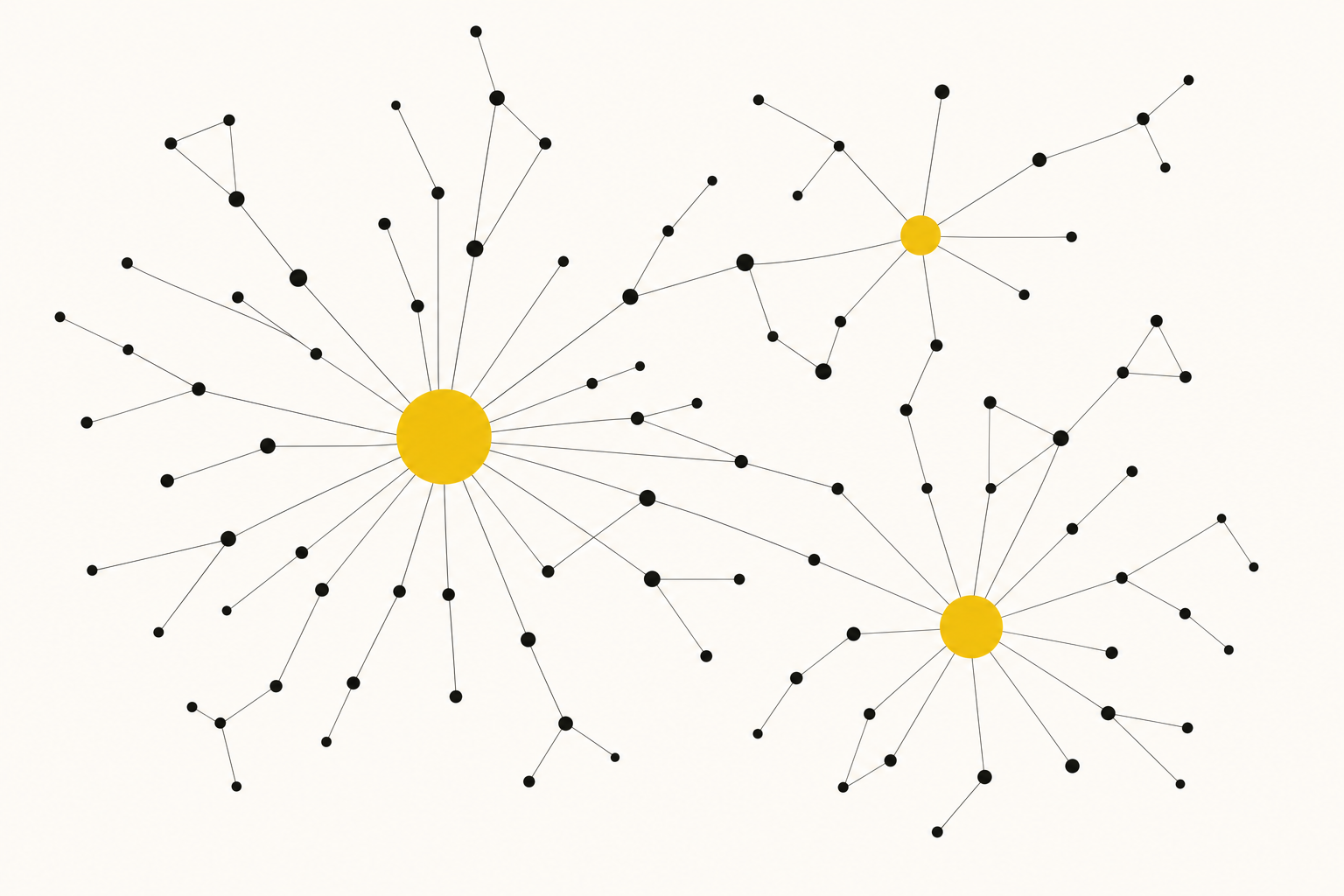
The physicists around H. Eugene Stanley at Boston University spent decades finding the same mathematics in wildly different systems — financial markets, polymers, the growth of cities, the Internet. Again and again the same signatures appeared: power laws, scaling, and a surprising way that large networks fail. Your AI operating layer is one of those networks, and it obeys the same rules whether or not you have noticed.
Your workflows form a graph, whether you drew it or not
Start with a single automated workflow: a trigger, a couple of connectors, a model, an approval, a delivery channel. Harmless. Add a second workflow and it reuses the ERP connector. A third shares the identity provider. A fourth calls the same model gateway. Within a quarter you have not built four workflows — you have built a graph: nodes are connectors, agents, and data sources; edges are the dependencies between them.
Nobody designed this graph. It accreted. And its behavior is now governed by network science, not by any one workflow's design.
Value follows a power law — and so does risk
Barabási and Albert showed in 1999 that networks which grow by preferential attachment — new nodes connecting to already-popular nodes — become scale-free: a few hubs accumulate a huge share of the connections, while most nodes have very few. Your integration graph grows exactly this way. New workflows attach to the connectors that already exist, so the ERP connector, the shared model gateway, and the identity provider quietly become hubs carrying most of the load.
This is wonderful for value: reuse compounds, and each new workflow is cheaper than the last. It is dangerous for risk: the same hubs that create leverage concentrate fragility.
Percolation: networks fail suddenly, not gradually
Here is the result that should change how you operate. Cohen, Havlin, and colleagues studied how networks come apart, and found a sharp asymmetry. Scale-free networks are extraordinarily robust to random failures — knock out arbitrary nodes and the network barely notices, because most nodes are peripheral. But they are catastrophically fragile to targeted hub failure — take out the few high-degree hubs and connectivity collapses all at once, in a percolation-style phase transition.
Now look at your incidents. Your outages are not random. When the identity provider rate-limits you, or the shared model gateway degrades, or the ERP connector's credentials expire, every workflow that depends on that hub fails together. You do not lose 5% of capacity; you cross a threshold and lose the network. Teams experience this as "everything broke at once for no reason." Network science says the reason is structural and predictable.
Monitoring has to scale faster than the graph
Because dependencies grow superlinearly as you add workflows, a monitoring approach that watches individual workflows will fall behind. What matters is not the health of each node but the health of the hubs and the cut points — the nodes whose failure disconnects large regions. The practical move is to measure the graph itself: compute which connectors are load-bearing for the most workflows, and watch those first.
Design for hub resilience
Network science does not just diagnose; it prescribes. The mitigations are the ones distributed-systems engineering already knows, now aimed at the right targets:
- Redundancy on hubs. Model-agnostic routing so a single provider outage degrades rather than stops you. Backup credentials and failover for the ERP and identity hubs.
- Circuit breakers. When a hub degrades, trip fast so failing workflows do not stampede and turn a brownout into a collapse.
- Bulkheads. Isolate workflow families so one hub's failure cannot drain shared capacity (retries, queues, rate limits) from unrelated work.
- Graceful degradation. Define what each workflow does when its hub is down — queue and wait, fall back to a cached result, or escalate to a human — instead of failing blindly.
The takeaway
The uncomfortable truth from the Boston University tradition is that your AI platform becomes most fragile precisely as it becomes most valuable, because the reuse that creates value also creates hubs. You cannot avoid this by adding fewer workflows; you avoid it by treating the integration graph as a first-class object — measuring it, finding its hubs, and hardening them before percolation finds them for you.
References
- Albert-László Barabási and Réka Albert, Emergence of Scaling in Random Networks, Science, 286(5439), 1999.
- Reuven Cohen, Keren Erez, Daniel ben-Avraham, and Shlomo Havlin, Resilience of the Internet to Random Breakdowns, Physical Review Letters, 85(21), 2000.
- Rosario N. Mantegna and H. Eugene Stanley, An Introduction to Econophysics: Correlations and Complexity in Finance, Cambridge University Press, 2000.
- Albert-László Barabási, Network Science, Cambridge University Press, 2016.
Want a look at where your integration graph is load-bearing? Book a 30-minute technical review.