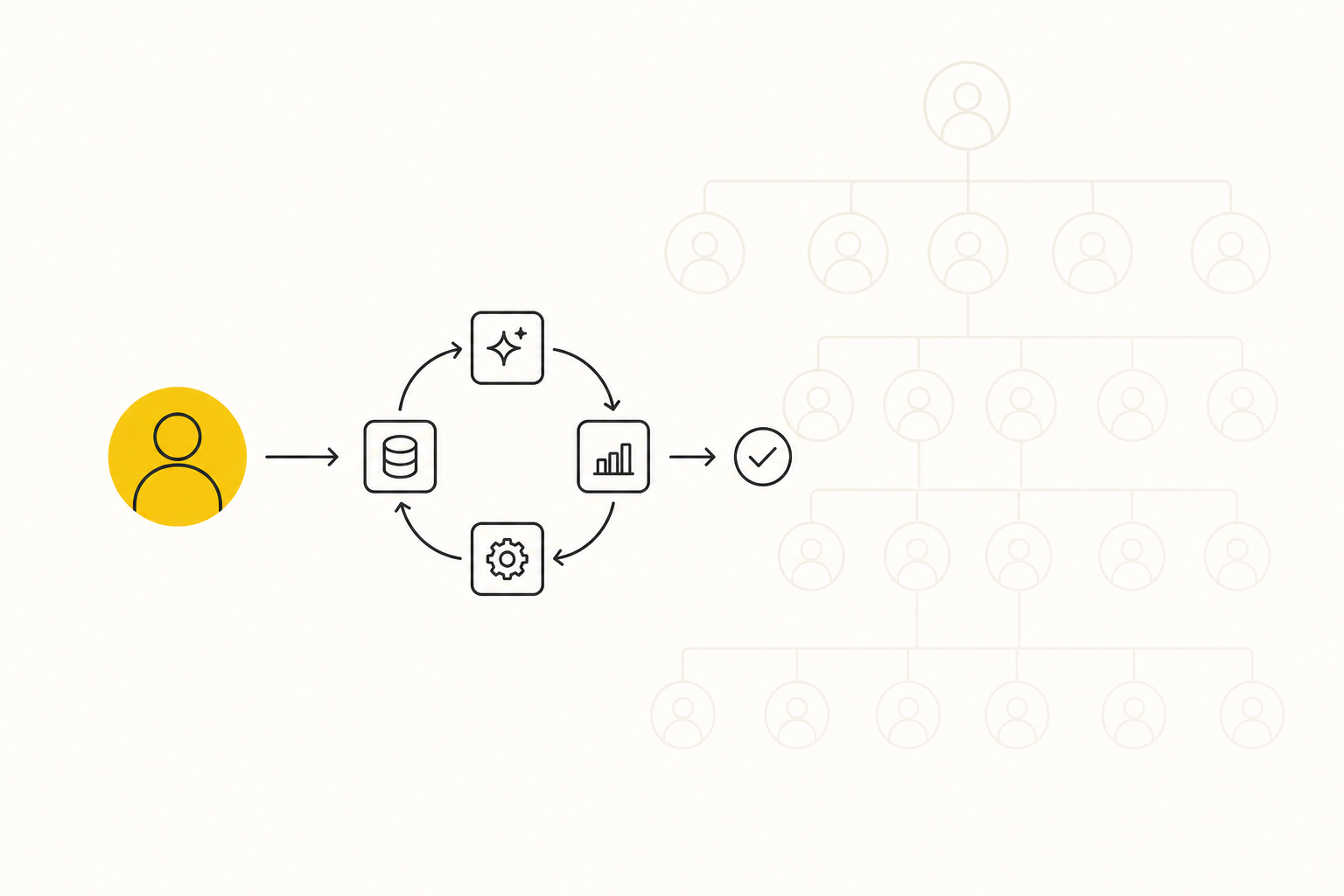
Almost every article about "enterprise AI" quietly assumes something a 30-person company does not have: a data science team, an ML platform, a budget with a comma in it, and a year to spend. So the owner of a small distribution business or a regional accounting firm reads it, concludes AI is for companies ten times their size, and goes back to work.
That conclusion is wrong, and it is costing small companies the advantage they are best positioned to capture. You do not need a data science team to deploy AI. You need one owner, one workflow, and about a week.
The advice was written for the wrong company
The standard enterprise playbook — build a platform, hire ML engineers, run a governance committee, launch a transformation program — exists because large organizations have large coordination problems. A 5,000-person company needs a committee because 5,000 people cannot agree informally.
A small company has the opposite situation, and it is a gift. There is no committee to convince. The person who feels the pain, the person who owns the process, and the person who can say "yes, ship it" are often the same person, or sitting ten feet apart. That collapses the timeline the enterprise playbook assumes. You are not a smaller version of a big company's AI problem. You are a fundamentally easier one.
Buy the capability, do not build the team
The reason the "hire a data scientist" advice is wrong for you is that you are not trying to invent AI. You are trying to use it. A small business does not build its own payroll software or its own email server, and it does not need to build its own AI infrastructure either. The models, the connectors, the guardrails, the approval routing — those are the parts to buy, so your one owner can spend their week on the only thing that cannot be bought: knowing how the work actually gets done in your business.
That is the real requirement. Not a PhD. Not Python. Someone who knows what a good quote looks like, which customers are sensitive, and when a number is wrong. That knowledge already exists in your building. It is walking around in the head of your best operations person.
Pick the one task that person complains about most
Do not start with an "AI strategy." Start with the single recurring task your best person grumbles about every week — the quote they retype, the follow-up emails they never get to, the monthly report that eats a Friday. It repeats, it has an obvious owner, the data already lives in your existing tools, and the outcome is measurable in hours. That is the entire selection criterion, and small companies can usually name the task in one sentence.
Ship in a week, because you can
Week one, not week one of quarter three. Connect the AI to the systems you already use — your inbox, your spreadsheet, your accounting tool. Have your one owner review every output for a few days and correct it. Keep a human approving anything that leaves the building. Then look at the numbers: hours saved, turnaround time, corrections needed. If it works, do it again on the next task. If it does not, you spent a week, not a year.
Why moving now matters more for you than for them
Research on how new technology spreads shows a familiar pattern: adoption starts slow, then tips, and the businesses that move before the tipping point capture disproportionate advantage while the laggards spend years catching up. Small companies usually assume they will be the laggards on AI because they lack the resources of the giants. It is exactly backwards. Your lack of committees, legacy platforms, and internal politics is why you can move first. The giant has to convince a boardroom. You have to convince one owner — and they are already annoyed by the task you are about to fix.
References
- Everett M. Rogers, Diffusion of Innovations, 5th ed., Free Press, 2003.
Want to pick the one workflow your best person would thank you for automating? Book a 30-minute call and we'll find it together.