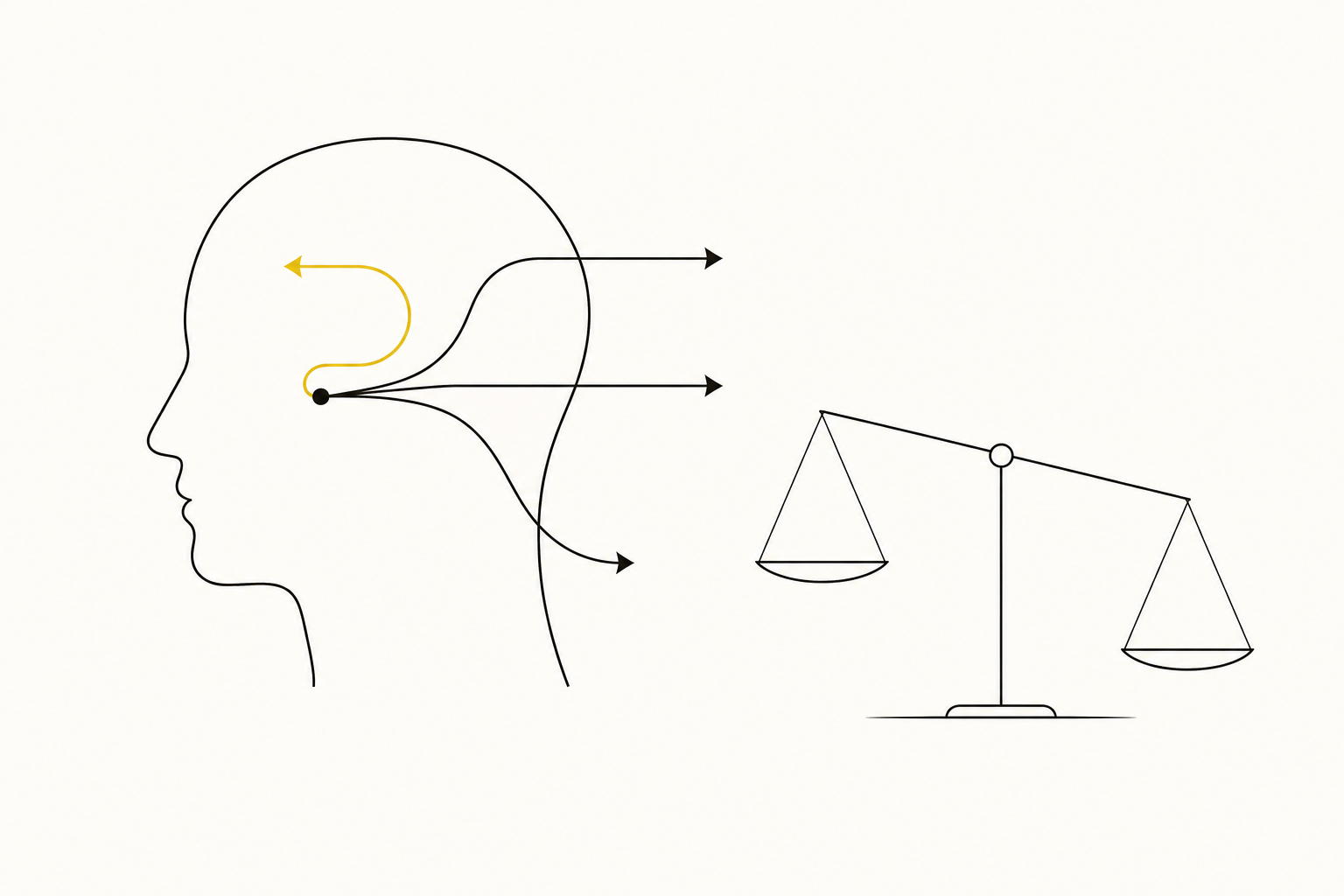
Daniel Kahneman and Amos Tversky spent a career proving something uncomfortable: the human mind is not a broken calculator that occasionally errs at random. It errs systematically, in predictable directions, and it does so most confidently when it feels most certain. Richard Thaler took that insight into the world of money and organizations and showed that the same predictable errors shape how firms spend, budget, and decide.
When we watch an enterprise AI initiative stall, the post-mortem almost never blames the model. It blames "culture," "change management," or "timing." Those are labels, not explanations. The real explanations are older and better documented — they live in the behavioral-economics literature. Three biases, in particular, kill more AI rollouts than any technical limitation.
Zero-sum bias: "if the AI wins, I lose"
Daniel Meegan formalized zero-sum bias — the intuition that one party's gain must come at another's expense, even when resources are not actually fixed. It is a deep heuristic: for most of human history, more for you really did mean less for me.
Inside a company, this bias is the quiet engine of AI resistance. The salesperson whose quotes the AI now drafts does not hear "you get three hours of your week back." They hear "the thing that made me valuable is being automated." The AR clerk does not hear "the collections grind is handled." They hear "I am being replaced." The math of the situation is positive-sum — the human moves up the value chain while the agent handles the repetitive work — but the felt math is zero-sum, and people act on what they feel.
You cannot argue someone out of a bias with a slide. You design around it. That means deploying AI on the work people already resent, keeping the human as the approver and owner rather than the bystander, and measuring success as hours returned to higher-value work, not headcount removed. When the person whose workflow you automated becomes the person who governs the agent, the perceived competition dissolves — because it was never actually a competition.
Mental accounting: the AI budget in the wrong ledger
Thaler's mental accounting describes how people and organizations sort money into separate, non-fungible mental buckets and then make irrational decisions to protect the boundaries between them. A dollar is a dollar, but a dollar in the "innovation budget" is treated very differently from a dollar in the "operations budget."
This is why so many AI programs are quietly doomed by their own accounting. The cost of an AI initiative lands in an "AI/innovation" line item, while the value it produces — a shorter quote cycle, recovered receivables, avoided errors — accrues to sales, finance, and operations. The initiative is then judged against the innovation ledger it debits, not the operational ledgers it credits, and it looks expensive because the benefit was booked somewhere else.
Two more mental-accounting traps follow closely:
- Sunk-cost lock-in. A failed pilot sits in its own account, and rather than write it off, teams keep funding the sunk approach to avoid "wasting" what they already spent — Thaler's classic sunk-cost fallacy in organizational form.
- The pilot slush fund. AI is funded as a one-off experiment rather than as operating infrastructure, so it never gets the ongoing budget that production systems require, and it dies the moment the experimental money runs out.
Normalcy bias: "our processes are fine, and they always will be"
Normalcy bias is the tendency to underestimate the likelihood and impact of a disruption because things have been normal for so long. It is what keeps people seated when the fire alarm sounds. In the enterprise it shows up as a serene confidence that the current way of working — the manual quote, the spreadsheet reconciliation, the inbox-driven follow-up — is not just tolerable but permanent.
Normalcy bias cuts in two directions for AI, and both are dangerous.
First, it makes the status quo feel safe when it is quietly eroding. The three-hour quote that loses deals to a faster competitor does not trigger alarm, because it has always taken three hours. The 40% of follow-ups that never happen feel normal because they have always not happened. The cost of inaction is invisible precisely because it is familiar.
Second, and just as damaging, normalcy bias makes teams underprepare for AI's own failure modes. Because the demo worked and the first hundred runs were clean, people assume the agent will keep behaving — so nobody builds the guardrails, the approval gates, the tracing, or the safe-mode fallback. The rollout runs fine right up until the run that does not, and then there is no plan, because "it had always worked."
The antidote is the same discipline in both directions: treat neither the status quo nor the new system as permanently safe. Quantify the cost of the current process so inaction stops being invisible, and instrument the AI system so its inevitable bad run is caught by a sensor instead of a customer.
Design for the mind you actually have
The through-line from Kahneman, Tversky, and Thaler is that you do not defeat systematic bias with willpower or a better argument. You defeat it with choice architecture — structuring the decision so the biased default is the good one.
For enterprise AI that means: put the resisting human in the approver's seat so zero-sum fear turns into ownership; account for cost and value in the same ledger so mental accounting stops hiding the return; and instrument both the old process and the new agent so normalcy bias cannot keep either failure invisible. The technology has been ready for a while. The rollout succeeds when you design it for the mind that has to adopt it.
References
- Amos Tversky and Daniel Kahneman, Judgment under Uncertainty: Heuristics and Biases, Science, 185(4157), 1974.
- Daniel V. Meegan, Zero-Sum Bias: Perceived Competition Despite Unshared Resources, Frontiers in Psychology, 1:191, 2010.
- Richard H. Thaler, Mental Accounting Matters, Journal of Behavioral Decision Making, 12(3), 1999.
- Richard H. Thaler and Cass R. Sunstein, Nudge: Improving Decisions About Health, Wealth, and Happiness, Yale University Press, 2008.
- Daniel Kahneman, Thinking, Fast and Slow, Farrar, Straus and Giroux, 2011.
Want to design an AI rollout that works with your team's instincts instead of against them? Book a 30-minute call.