Students at Harvard Business School never get the answer. They get a protagonist, a decision to make, imperfect information, and real consequences. The case method forces three questions before any clever solution: Who owns this decision? What are they accountable for? What happens when it is wrong?
Those questions matter far more to enterprise AI than which model you picked. Most teams debate capabilities and skip governance entirely — and then wonder why their impressive pilot never ships.
Most teams ship the actuator and skip the decision
The failure pattern is consistent. A team builds an agent that can draft the quote, send the email, or move the money. The demo lands. Then someone senior asks: who approves this before it reaches a customer? Silence. The project stalls, not because the AI is incapable, but because nobody assigned the decision.
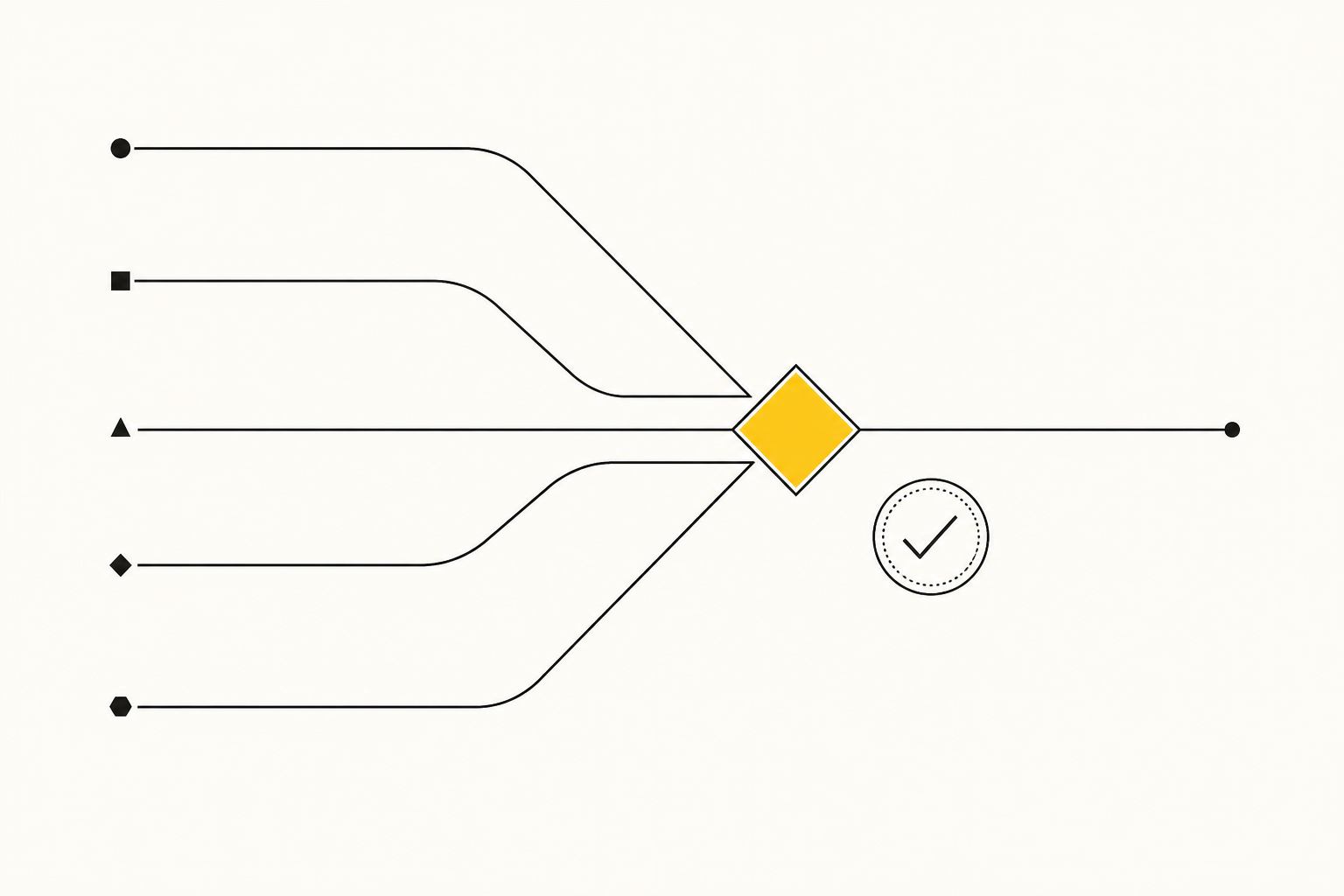
An approval gate is where that assignment lives. It is not a speed bump in a workflow diagram; it is the software encoding of who is allowed to commit the company to an action.
Agency theory: the moment you delegate, you inherit a control problem
In 1976, Jensen and Meckling formalized what every manager feels intuitively. The instant a principal delegates work to an agent, their interests diverge, and the principal must spend on monitoring and incentives to keep the agent aligned. This gap has a name — agency cost — and it never fully closes.
An AI agent is, in this precise sense, the ultimate agent: tireless, literal, fast, and utterly without skin in the game. It will not feel the reputational sting of a badly worded collections email or the loss from a mispriced quote. So the agency-cost framing tells you exactly where to invest: monitoring (tracing and evals) and aligned control (approvals). You are not adding bureaucracy — you are paying the irreducible cost of delegation, deliberately, where it is cheapest.
Who has the D?
In a much-cited Harvard Business Review article, Rogers and Blenko argued that most organizational dysfunction is really ambiguity about decision rights — nobody knows who holds the D. Their fix is to make roles explicit: who recommends, who is consulted, who decides, who is accountable, who is merely informed.
An approval gate is decision-rights notation made executable. Designed well, it answers, for every category of output:
- Amount-based — quotes above a threshold go to a manager; below it, auto-approve.
- Customer-based — VIP accounts always get human review; standard accounts follow the threshold.
- Content-based — anything customer-facing is reviewed; internal summaries can auto-complete.
- Channel-based — the decision reaches the decider where they already work: email, Slack, Teams, or the board.
Accountability needs a record, not a vibe
Alfred Chandler's The Visible Hand told the story of how the modern firm scaled: not through charisma but through managerial hierarchies and systematic recordkeeping. The railroads and the great enterprises that followed grew because they could track who decided what, and hold them to it.
AI raises the stakes. When an agent produces thousands of outputs a week, "we trust our people" does not scale as an accountability model. What scales is the audit trail: who approved this output, when, what the original AI draft was, and what they changed. That record is not compliance theater. It is the visible hand — the thing that lets a company delegate at machine speed without losing track of who is answerable.
The case-method takeaway
Bring it back to the three questions.
Who owns this decision? The approval gate names them, per category, in software.
What are they accountable for? Exactly the outputs routed to them — no more, no less — with a record of what they signed.
What happens when it is wrong? You can trace it to a specific decision, a specific approver, and a specific change, and you can improve the rule so the same error routes for review next time.
Skip these and you have a demo. Answer them and you have something a board will let you run. The model was never the hard part. The decision rights were.
References
- Michael C. Jensen and William H. Meckling, Theory of the Firm: Managerial Behavior, Agency Costs and Ownership Structure, Journal of Financial Economics, 3(4), 1976.
- Paul Rogers and Marcia Blenko, Who Has the D? How Clear Decision Roles Enhance Organizational Performance, Harvard Business Review, 2006.
- Alfred D. Chandler Jr., The Visible Hand: The Managerial Revolution in American Business, Belknap Press of Harvard University Press, 1977.
- Herbert A. Simon, Administrative Behavior: A Study of Decision-Making Processes in Administrative Organizations, 4th ed., Free Press, 1997.
Want to map the decision rights for your first AI workflow? Book a 30-minute call.