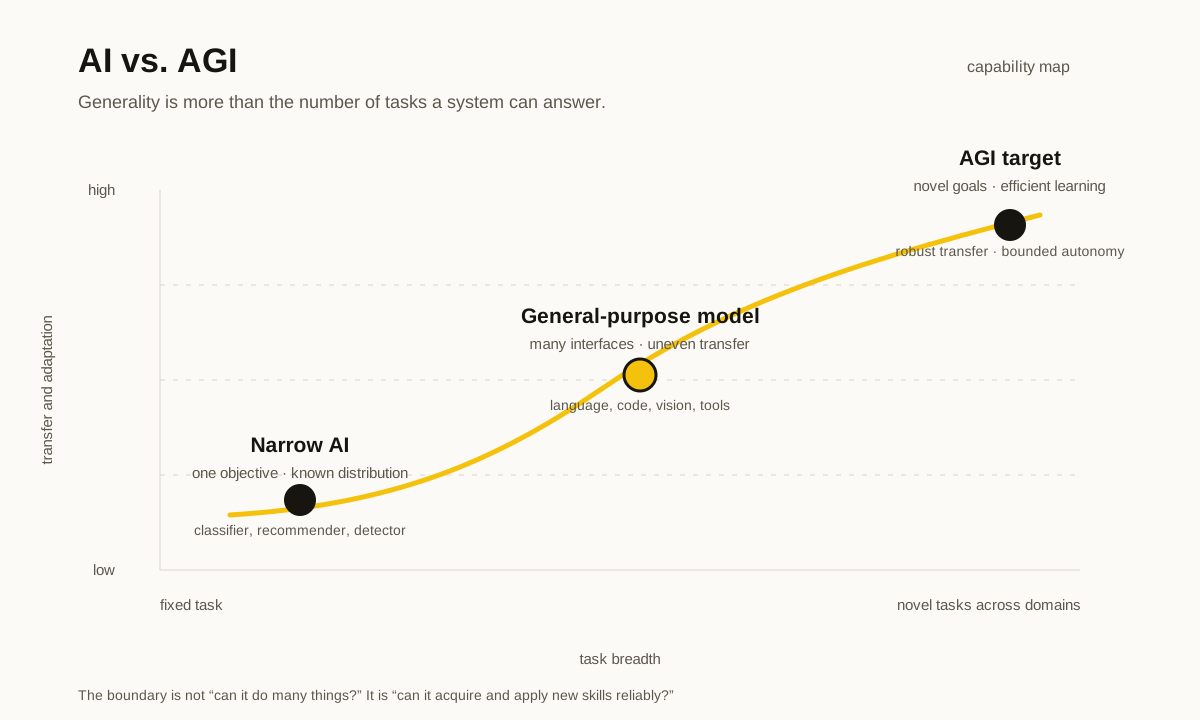
The phrase artificial intelligence describes a field. Artificial general intelligence describes a target: a system that can acquire and apply useful skills across a wide range of unfamiliar problems, with much less task-specific engineering than a collection of narrow systems would require.
Those are not two competing products. AGI is a demanding point in the larger design space of AI. A system can be astonishingly capable at many familiar tasks without being general in the technical sense.
Start with sets, not slogans
AI is the umbrella term for computational systems that perform tasks we associate with intelligence: perception, prediction, planning, language use, decision-making, control, and learning. A spam classifier, a route optimizer, a protein-folding system, a large language model, and a robot controller can all be called AI even though they have very different architectures.
AGI is narrower as a claim and less settled as a definition. A useful engineering interpretation is that an AGI-like system should combine:
- Breadth: it works across substantially different domains, not just many variants of one benchmark.
- Transfer: it reuses abstractions and strategies in a new task instead of starting from a task-specific training pipeline.
- Adaptation: it learns a new skill from instructions, examples, interaction, or experimentation with reasonable sample efficiency.
- Robustness: its performance does not collapse under modest changes in wording, environment, tools, or objective.
- Bounded autonomy: it can execute long-horizon work while representing uncertainty and respecting permissions.
The technical boundary is transfer
Suppose a model is evaluated on a distribution of tasks D. A narrow system is usually optimized for high expected performance on a fixed or slowly changing portion of D. Its training objective, data pipeline, output format, and evaluation suite are shaped around that scope.
That is not a weakness. Narrowness is often an engineering advantage. A visual inspection model can be safer and cheaper than a general agent when the job is to detect one known class of defect. A fraud detector does not need to write a legal memo.
The AGI question appears when we move to a new task distribution D′: unfamiliar rules, sparse examples, a different interface, and no bespoke fine-tuning. The relevant quantity is not only performance on D, but the cost of acquiring competence on D′.
A useful mental model is:
generality ≈ breadth of task scope × efficiency of skill acquisition × reliability under change
This is why raw benchmark scores are insufficient. A system may have memorized prior knowledge, received extensive scaffolding, or been tuned for the test. François Chollet’s work on intelligence makes a related point: skill on a task is not the same thing as the efficiency with which a system acquires skill on new tasks.
Why “it can do many things” is not enough
Foundation models increased breadth dramatically. One model can translate, summarize, write code, interpret images, call tools, and follow a conversation.
But breadth at the interface is not identical to general intelligence. A model may still depend on:
- a training corpus containing close analogues of the task;
- carefully designed prompts, examples, tools, and external scaffolding;
- a human who decomposes the work, checks intermediate state, and repairs failures;
- stable APIs and clean context windows that do not exist in the real environment;
- a benchmark whose task format is known or easy to infer.
Model generality and system generality
An AI product is rarely just a model. It is a system with memory, retrieval, tools, planners, verifiers, permissions, schedulers, and a user interface. These components can make a model look much more capable, and good engineering should use them.
The system boundary still needs to be explicit. A tool-using agent may solve a broad set of tasks because engineers encoded the decomposition, tool contracts, and recovery paths. That is valuable general-purpose automation. It should not automatically be described as evidence that the underlying model has general intelligence.
The honest question is: which capabilities are learned by the model, which are provided by the operating layer, and which require a human in the loop?
Autonomy is a separate axis
Generality and autonomy should be measured separately. A narrow warehouse controller can be highly autonomous. A research copilot can be broad but low-autonomy because a person approves every action.
A serious evaluation should report at least:
- Performance: how well does the system solve the task?
- Generality: how far does competence transfer across domains and novel tasks?
- Autonomy: how much of the planning and execution loop can it own safely?
What to test
A credible evaluation should include more than a leaderboard score:
- novel task families whose rules are not in the training distribution;
- few-shot adaptation from a specification or small demonstrations;
- cross-domain transfer;
- perturbations to wording, tools, interfaces, and irrelevant details;
- long-horizon execution with recovery from errors;
- calibration: confidence and escalation should track uncertainty;
- resource accounting for compute, latency, tool calls, and human intervention.
Engineering for useful generality today
Teams do not need to wait for a consensus definition of AGI:
- Define a family of tasks, not a single happy-path demo.
- Hold out task templates, environments, and edge cases before development.
- Measure transfer, correction rate, cost, latency, and human intervention.
- Give memory and tools explicit, versioned contracts.
- Route uncertain or high-impact actions to a human approval gate.
- Log the model, prompt, tools, retrieved context, decisions, and outcome.
The short answer
AI is the broad field and umbrella category. AGI is a hypothesized capability level within that field: broad competence, efficient learning on unfamiliar tasks, robust transfer, and enough bounded autonomy to pursue goals responsibly.
The difference is not how impressive the demo looks. It is whether the system can learn what it was not specifically prepared to do, carry that learning across contexts, and keep working when the environment changes.
Until that claim is tested with evaluations of novelty, transfer, adaptation, autonomy, and resource use, “AGI” is best treated as an evaluation hypothesis—not a marketing category.
References
- Shane Legg and Marcus Hutter, Universal Intelligence: A Definition of Machine Intelligence, 2007.
- François Chollet, On the Measure of Intelligence, 2019.
- Meredith Ringel Morris et al., Levels of AGI for Operationalizing Progress on the Path to AGI, 2023.
Want to turn a promising AI capability into a reliable business workflow? Book a 30-minute call and map the evaluation, approval, and operating layer around it.