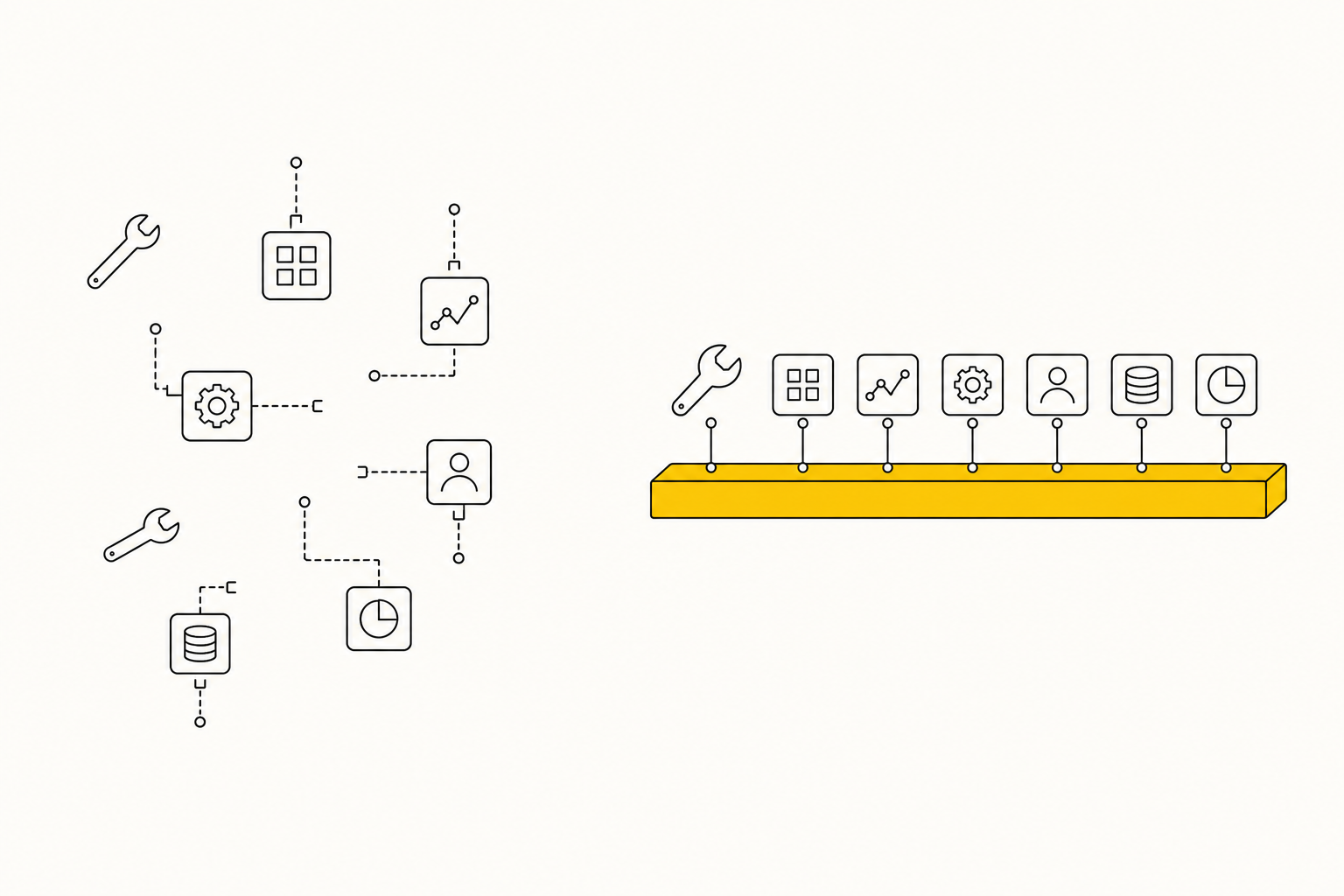
I'll lead with the answer: a company-wide AI platform is the better bet than buying a specialized tool for every job — and I'll defend that as a systems calculation, not a slogan. Best-of-breed is not stupid. Locally, it is often the smartest move available. The problem is that a sum of local smarts does not produce a global system.
Two options, two different optimizations
Most leadership teams face the same fork.
Path one: Each department buys the tool that best solves its own problem. Sales gets an RFQ/quoting tool, finance a collections assistant, support a ticket summarizer, marketing a content generator. Each can be "best" in its category. Classic best-of-breed.
Path two: The company manages agents and workflows on a single platform. Models can change, connectors can be added, approval rules stay shared. Business units still build their own agents; security, cost, traceability, and approval run on the same rails.
Both look like "we're using AI." The difference does not show up at three months. It shows up at eighteen — on the invoice, in the audit, and in the org chart.
Why best-of-breed is so seductive
Criticizing this choice without taking it seriously is bad judgment. The appeal is real:
- Fast wins. A team can buy a tool and demo it in two weeks. Platform onboarding looks slower.
- Category fit. A specialized product knows the jargon and edge cases of that job — at least in the sales deck.
- Diffused ownership. Each unit pays from its own budget; nobody waits for a central "AI decision." Politically comfortable.
- Vendor risk feels spread. Locking into one platform sounds scary; spreading spend across five vendors gets sold as "optionality."
In AI, the handoff is integration + context + approval + cost visibility.
Pros / cons — past the spreadsheet
The diagram below puts both architectures in one glance. On the left, every tool carries its own lock and its own invoice. On the right, agents sit on a shared platform rail; security and governance consolidate under one shield.
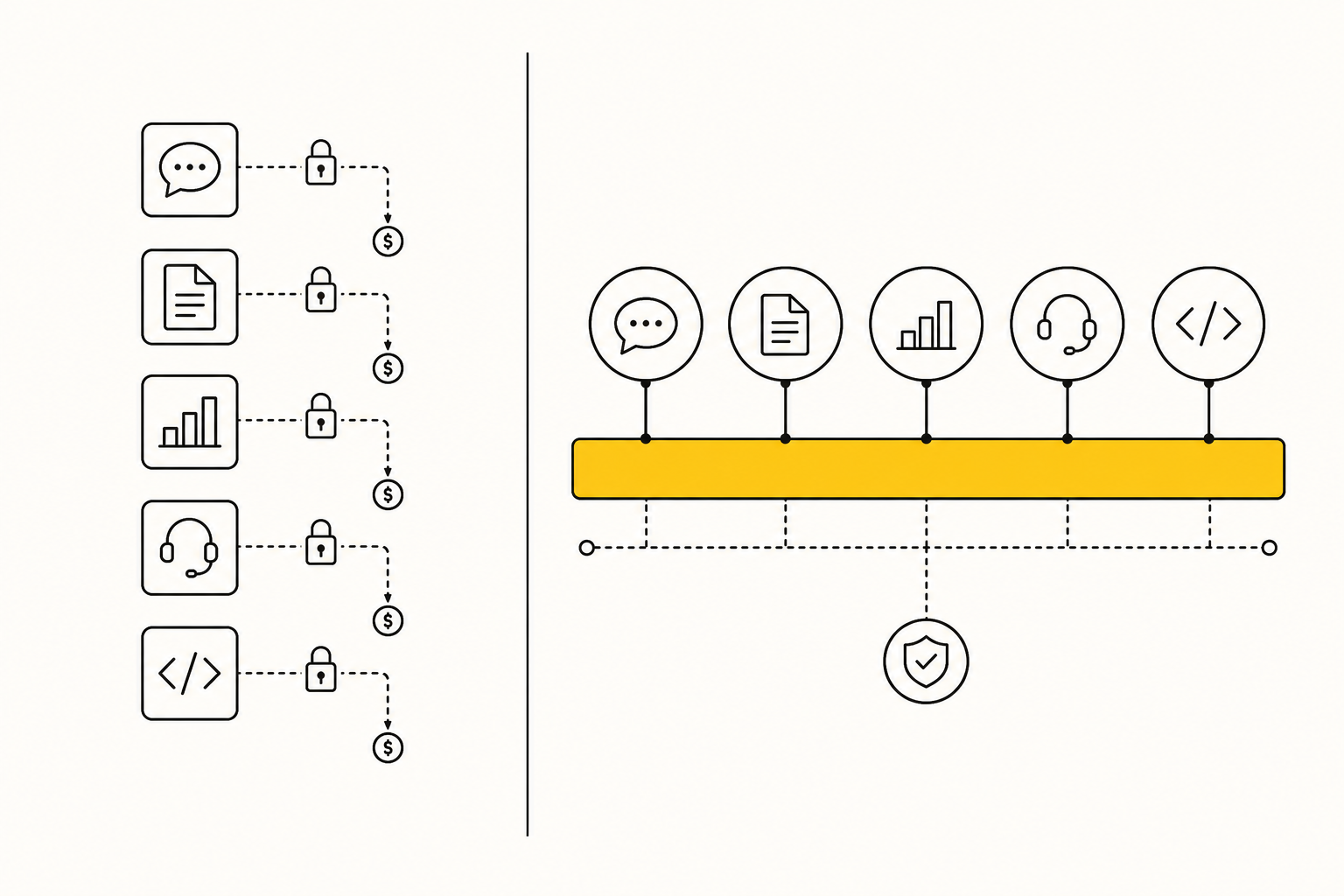
Specialized tool per job — pros. Fast local wins, category fit, unit autonomy. A team moves on its own budget; it does not wait for a central "AI decision."
Specialized tool per job — cons. Integration debt, a security review per vendor, fragmented invoices, context that never travels. The expensive part is not the license; it is the handoff.
Company-wide platform — pros. Shared connectors, approvals, guardrails, cost control; reusable workflows; one audit trail. Adding a new agent is not a new vendor onboarding — it is a new workflow on rails you already own.
Company-wide platform — cons. It demands onboarding discipline. Week one is an operating decision, not a magic demo. Pick the wrong platform and you have built a bad central system — which is why governance has to be part of the product, not a slide bolted on later.
Watch the asymmetry: the cons of specialized tools are invisible at purchase; the cons of a platform are visible on day one. People manage visible cost and accumulate invisible debt. That is why best-of-breed wins by default — until the system bill arrives.
Second-order effects — where the real math lives
At first order, best-of-breed wins: "This tool does that job well." At second order, the table flips.
1. Context does not travel. The quoting agent does not know customer risk; the collections agent does not see open quotes; support does not see the last invoice tension. Each tool is "smart" in its sandbox and blind across the company. Work breaks at department boundaries.
2. Integration is paid N times, not once. Five tools means five ERP/CRM/email connections — or worse, five CSV-export habits. Connector cost does not show up next to the license; it shows up on IT's calendar.
3. Governance multiplies; standards drop. For the CIO, every new SaaS is an attack surface, a DPA, an access review. Five "small" AI tools create more security work than one platform, not less — because each wants its own identity, logs, and retention policy.
4. The CFO cannot see one number. Token spend, seat licenses, overages, "we're just piloting this month" experiments… Fragmented AI cost disappears line by line in the budget. Without a kill switch, runaway cost is not an architectural feature; it is a surprise.
5. Learning does not stay in the firm. One team's prompts, approval edits, and failure modes do not transfer to another. Organizational memory scatters across vendor accounts. When someone leaves, the tool remains; the judgment does not — because the judgment was never encoded.
6. Shadow AI becomes inevitable. Without a central platform, people are already pasting into ChatGPT. An official best-of-breed strategy becomes, in practice, shadow AI + official SaaS. The surface you think you control is not the real surface.
The shared name for all of this: system cost. Not sticker price — the cost of operating AI as a company.
Four seats, four questions — one answer
This is not a one-person decision. Four roles read the same architecture through different questions; a good choice answers all four.
CEO — speed and coherence. Question: In eighteen months, will we have a pile of demos — or a repeatable operating capability? A platform turns AI from a project portfolio into an operating capability. Strategy is not handing every unit a different weapon; it is running different agents on shared rails.
CFO — visible unit economics. Question: What does each workflow cost, who blew the budget, where do we cut? On one platform, cost tracking, budgets, and kill switches are possible. Across five invoices, "what are we spending on AI?" becomes a PowerPoint. The CFO does not want magic; they want countability.
CIO — attack surface and compliance. Question: Where does the data go, who approved it, where are the logs? One identity model, one PII-masking policy, one audit trail — boring, and valuable for exactly that reason. The fastest path for compliance is not persuading every vendor separately; it is building the shared control plane once.
CTO — architectural debt and replaceability. Question: What breaks when the model changes? Can agents hand work to each other? Is there prompt and workflow versioning? On a well-built platform, the model is a commodity; the connector layer and the workflow contract are the product. In best-of-breed, every vendor imposes its own model path, lock-in, and roadmap. What you mistook for optionality is often fragmented dependency.
The shared answer across all four: local tools optimize; platforms coordinate. Companies do not exist for local optimization. They exist for coordination.
So — never buy a specialized tool?
Buy them — in the right place.
- For truly isolated, low-risk work that never touches company systems (internal brainstorming, public-facing copy), a personal productivity tool is fine.
- In a narrow domain your platform does not yet cover, treat it as a capability that must plug into the platform — data and approval stay on your rails.
- "We'll buy the tool now and integrate later" is not a strategy; it is deferral. Postponing integration is accepting debt with interest.
Where PromptRails sits
We did not build this distinction because it sounded good in theory. We built it because we kept seeing the same failure in the field. PromptRails does not sell every department a separate magic box. It lets you manage the agents and workflows you need on a single platform:
- Shared connectors to ERP, CRM, email, and internal systems
- Approval gates, guardrails, and PII masking in the same language on every workflow
- Traces that answer what happened, which data was used, and who approved
- Cost control that makes budgets and kill switches operable
- Adding a new agent means a new workflow on existing rails — not a new vendor onboarding
Best-of-breed promises variety. A platform promises that variety works as a system.
A decision frame for the next quarter
Three questions are enough:
- Twelve months from now, how many separate AI vendors will we be running SSO, DPAs, and access reviews with? If the number is climbing past five, you already have a platform problem — you just have not named it yet.
- Can one agent's output become another agent's input? If not, you have capabilities, not an operation.
- Can the CFO see cost per workflow on one screen? If not, you will not talk about savings; you will talk about surprises.
Want to put your agents and workflows on one set of rails? Book a 30-minute call and we'll map your current tool stack together.