Somewhere in your company right now, a smart, well-meaning employee is pasting a client contract into a consumer chatbot to summarize it before a meeting. They are not malicious. They are efficient. The tool is faster than reading twelve pages, it is free, and it is one browser tab away.
This is shadow AI, and every leader we talk to underestimates two things about it: how widespread it already is, and how badly the obvious response — a ban — makes it worse.
A ban does not remove shadow AI. It hides it.
The instinct, especially from security and legal, is to prohibit it. Send the memo: no external AI tools with company data. It feels responsible. It accomplishes almost nothing.
Prohibition does not change the incentive that created the behavior — the work is still faster with the tool. It just drives the behavior underground. Now the paralegal uses the chatbot on their phone instead of their laptop, off the corporate network, where you have zero visibility. You have not eliminated the risk. You have blinded yourself to it while leaving it fully intact. A control you cannot observe is not a control.
Shadow IT is a fifty-year-old problem wearing a new hat
None of this is new. Researchers who studied shadow IT — employees adopting unsanctioned tools to get their jobs done — found it emerges reliably wherever official systems are slower or clumsier than the alternatives people can reach on their own. The lesson from that literature is blunt: shadow adoption is a signal, not a crime. It tells you precisely where your sanctioned tooling is failing your own people.
Shadow AI is that same phenomenon, accelerated. The unsanctioned tool is now extraordinarily capable and available to everyone, so the gap between "what IT provides" and "what I can grab myself" has never been wider. Treating it as a discipline problem misreads it. It is a product problem.
The desire path principle
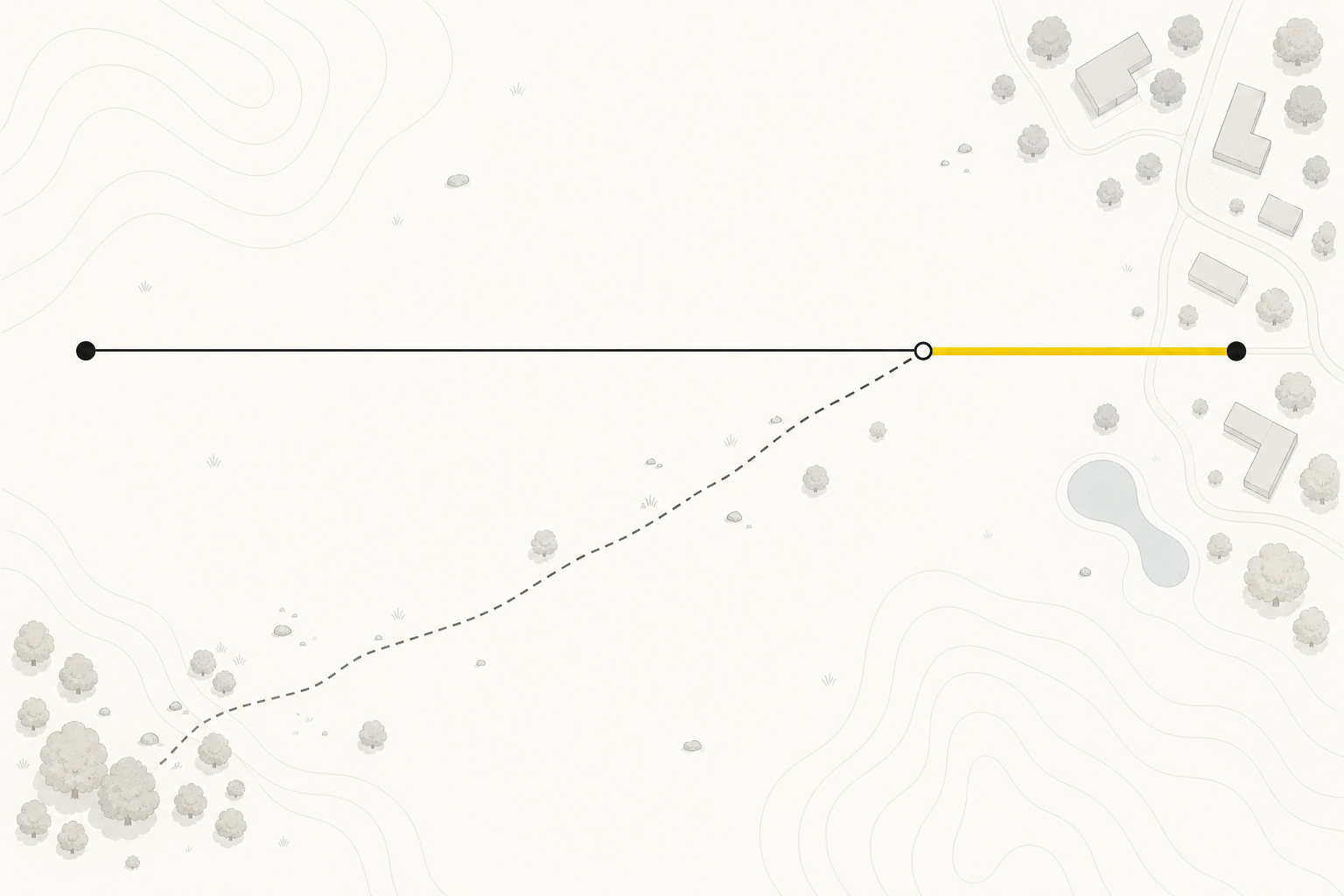
Landscape architects have a name for the dirt trails that cut across manicured lawns where the paved path took the long way: desire paths. The wise ones do not fence them off. They pave them, because the trail is the users telling you, with their feet, where the route should have gone.
Shadow AI is a desire path worn into your organization. Your people have shown you exactly which tasks they want help with — summarizing, drafting, extracting, translating. Fencing that off with a policy is how you get resentment and a phone full of unsanctioned tabs. Paving it — providing a governed way to do the very thing they are already doing — is how you convert risk into a managed capability.
Win on convenience, because that is the only thing that works
Here is the uncomfortable truth: the governed path only wins if it is easier than the shadow one. Employees did not choose the consumer chatbot because they hate compliance. They chose it because it was one tab away. A sanctioned tool that requires three approvals and a ticket loses to a free website every single time.
So the design goal is not "lock it down." It is "make the safe path the path of least resistance." That means a governed workflow where PII is masked automatically before anything reaches a model, where sensitive data can be kept inside your own boundary, where every use is logged and auditable — but which, to the employee, feels as effortless as the tab they were about to open. Give them that, and shadow AI does not need to be banned. It becomes obsolete, because the official path is now the fast one.
The choice was never "shadow AI or no AI." It is "shadow AI you cannot see, or governed AI you can." Turning off the lights does not make the room empty. It just means you stop seeing what is in it.
References
- Mario Silic and Andrea Back, Shadow IT – A view from behind the curtain, Computers & Security, Vol. 45, 2014.
Want to give your team a governed AI path that beats the shadow one on convenience? Book a 30-minute call.