Imagine a profitable industrial distributor with 120 employees. Orders are growing. The founder still approves ordinary discounts, the operations director reconciles delivery promises, and one accountant knows which receivables are genuinely collectible. When these three people are unavailable, the business slows down.
Now imagine a 25-person company whose teams can make routine commitments, handle exceptions within clear limits, and improve their methods from recorded outcomes.
The first company is larger. The second has built more organizational capacity. This hypothetical comparison reveals a useful starting point: a company's stage is best diagnosed by the constraint it repeatedly encounters. Revenue alone will not tell you what the organization can do without extraordinary effort.
That distinction matters when buying AI. Faster document production can relieve an information bottleneck. It cannot, by itself, resolve a founder's unwillingness to delegate or a business model customers no longer want.
A framework for diagnosis, with seven stages
Growth research offers a useful precedent: Greiner describes periods of organizational growth interrupted by management crises. The challenge changes as the organization develops. Greiner, Evolution and Revolution as Organizations Grow.
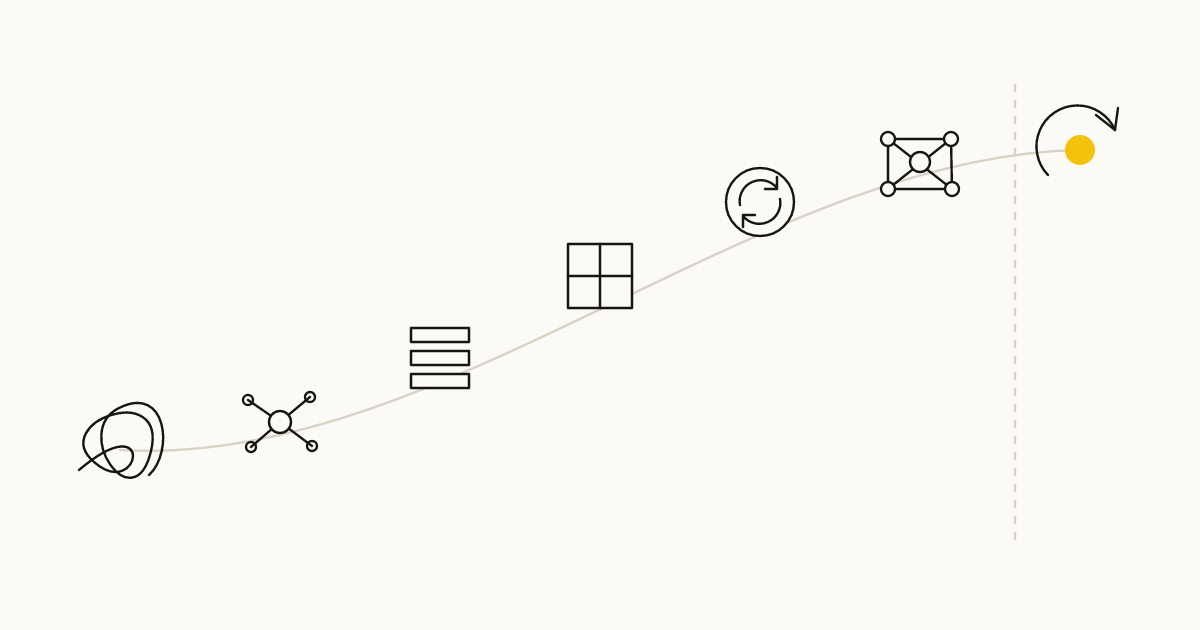
The seven stages below are this article's working framework, not a validated academic scale. They connect two questions: how reliably can the company operate, and how much of the world can its capabilities change?
The first five stages describe operating capability. Stages six and seven describe an expansion in strategic scope. They are optional directions, not graduation requirements. A company can pursue frontier research while still struggling with routine operations; a disciplined regional manufacturer may have no reason to become a platform.
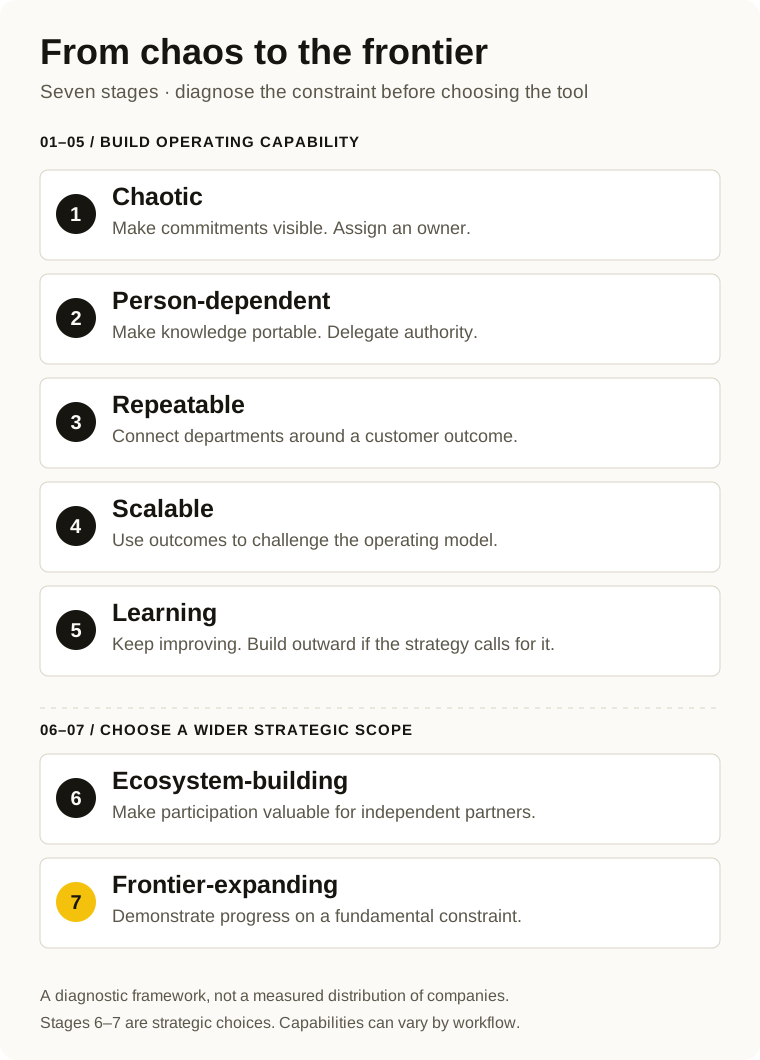
1. Chaotic: every day is a recovery operation
Work moves according to urgency. Priorities change when the next customer calls. The company cannot consistently explain what is outstanding, who owns it, or what completion means. Customers may still be delighted, but delivery depends on repeated rescue efforts.
Symptoms: requests disappear between email and messaging apps; commitments conflict; employees ask who is handling the same issue; yesterday's emergency returns next week.
The immediate constraint is visibility and ownership. To reach stage two, establish a dependable way to capture commitments, assign one responsible person, and review what remains unresolved. At this point, even a shared work board may be a substantial improvement.
Where AI helps: extract requests from messages, draft task records, summarize open commitments, and flag missing information for review. Give it a bounded intake role. When nobody has agreed on priorities, an autonomous agent simply executes one interpretation of the confusion.
Evidence of progress: fewer lost requests and overdue commitments, measured against an initial baseline. The relevant achievement is that work becomes visible and someone reliably carries it through.
2. Person-dependent: the company works because certain people do
Customers receive consistent service, but a handful of experienced employees supply the missing operating system. The founder is the approval queue; the sales veteran remembers pricing exceptions; the plant manager knows what the planning software omits.
Symptoms: routine decisions wait for named individuals; holidays create backlogs; new hires shadow someone for months; explanations begin with “ask her—she knows.” This pattern can persist in an old, profitable company.
The constraint is concentrated knowledge and authority. Reaching stage three requires capturing how routine decisions are made, training substitutes, and delegating within explicit limits. Documentation alone is insufficient if every decision still returns to the same desk.
Where AI helps: turn reviewed case histories into searchable guidance, draft standard procedures, and retrieve the source behind a recommendation. Experts must validate the result: a plausible reconstruction of company policy is not company policy.
Evidence of progress: trained colleagues complete a representative set of routine cases while the usual expert is away, with acceptable quality and fewer escalations. AI can help distribute knowledge. The authority to use it must come from management.
3. Repeatable: departments work, but the handoffs do not
The company has procedures, owners, and reasonably stable outputs. Yet each department optimizes its own work. Sales promises delivery before checking capacity. Finance requests information already entered elsewhere. A transaction spends more time waiting between teams than being processed within them.
Symptoms: spreadsheets reconcile different versions of the truth; data is entered repeatedly; local targets are met while customers still wait; exceptions have no clear route.
The constraint is coordination across functions. Reaching stage four requires an owner for the complete customer outcome, shared definitions, connected records, and agreed decision rights at the handoffs.
Where AI helps: interpret an incoming request, assemble relevant records, draft the next action, and route uncertain cases. Use ordinary software for exact calculations and stable rules. Language models are useful where the input requires interpretation; adding one to a deterministic calculation usually adds unnecessary uncertainty.
Evidence of progress: the full order-to-delivery or request-to-resolution cycle shortens without increased rework. A quote drafted in seconds has little value if it spends four days waiting for approval.
4. Scalable: growth no longer requires constant executive intervention
Teams can act within defined boundaries. Responsibilities, data, and escalation paths support expansion. The company can add customers or operating units without having senior management personally coordinate every additional transaction.
Symptoms: service levels are predictable; managers spend more time on exceptions; capacity and cost are visible. The warning sign is that a well-run system keeps applying yesterday's assumptions to a changing market.
The constraint now is adaptation. To reach stage five, build a disciplined loop between customer outcomes, operating decisions, and changes to the system. Someone needs the mandate and budget to challenge the process, not merely enforce it.
Where AI helps: detect emerging patterns in complaints, investigate unusual outcomes, and propose experiments. Record model and workflow changes, test against real cases, and track the cost of human review. A fluent explanation is a hypothesis to investigate.
Evidence of progress: teams can show which measured result caused a process or resource-allocation decision to change. Reporting becomes learning only when it alters action.
5. Learning: the company improves how it decides
Experiments have owners, hypotheses, and stopping conditions. Failed initiatives can be closed without concealing their results. Customer evidence can change a plan, including a plan sponsored by a powerful executive.
Symptoms: teams distinguish forecasts from observations; reviews examine assumptions; lessons survive employee turnover; successful experiments become normal practice. Innovation is visible in changed behavior, not just an annual presentation.
This can be an excellent destination. If the strategy calls for stage six, the next constraint is making internal capabilities useful to independent organizations. That requires partner economics, interfaces, service commitments, and a reason for others to participate.
Where AI helps: synthesize customer research with traceable sources, explore scenarios, and reduce the cost of testing ideas. It can also support partner documentation and onboarding. It cannot establish demand by generating persuasive descriptions of hypothetical customers.
Evidence of a move toward stage six: external partners repeatedly build or deliver something valuable using the company's capabilities, on terms that work for both sides. Signing partnership announcements does not establish an ecosystem.
6. Ecosystem-building: other businesses can build on yours
The company supplies a capability around which others organize part of their activity. This might be a software platform, an industrial service network, or shared logistics infrastructure. Its strategic reach grows through complementary businesses as well as its own employees.
Symptoms: partner investment depends on your interfaces and reliability; changes to your rules affect other businesses; a product decision becomes a question about value distribution, access, and trust.
The constraint is governing interdependence. Successful participation must remain economically attractive to partners. If the company chooses to pursue stage seven, it also needs patient capital, specialized talent, and a credible research agenda addressing a fundamental limit.
Where AI helps: improve partner support, match needs to capabilities, and coordinate complex information flows. Permissions, contractual boundaries, and shared standards still require deliberate institutional design.
Evidence of a frontier commitment: funded programs with testable technical milestones and independent evaluation. A larger distribution network expands reach; changing what becomes technically or economically possible is a different undertaking.
7. Frontier-expanding: enlarging the world's set of possibilities
At this stage of ambition, the company works on a constraint that extends beyond its existing market. Progress may enable activities that were previously impractical, prohibitively expensive, or technically unavailable.
SpaceX is a useful illustration: Falcon 9 demonstrates reusable launch technology, while the company's stated mission extends to making humanity multiplanetary. A demonstrated vehicle capability and a long-term mission are different kinds of evidence. SpaceX: Falcon 9, SpaceX: Mission.
OpenAI illustrates the cognitive version of this ambition. Its charter centers on ensuring that AGI benefits humanity. That stated mission explains its relevance here; it does not establish that AGI has been achieved or that the company has resolved every organizational challenge. OpenAI Charter.
Symptoms: a substantial research portfolio addresses fundamental constraints; success requires capabilities that do not yet reliably exist; progress needs external scrutiny; consequences extend beyond direct customers.
Where AI helps: assist literature review, code, simulation analysis, and candidate generation, with domain-specific validation. It cannot replace physical experiments, establish a discovery through confident prose, or decide whose interests should govern a technology's deployment.
There is no eighth stage in this framework. The next step is a credible frontier milestone while preserving operational reliability and accountability. A mission describes the horizon; evidence establishes how far the company has moved.
Where are most companies?
The practical center of this framework is the stage-two-to-stage-four transition: moving from dependence on people to dependable processes and coordinated execution. My working hypothesis is that this is where most established businesses face their central organizational challenge. It is a diagnostic proposition, not a measured global distribution.
The World Bank reports that SMEs represent around 90% of businesses globally. That establishes how unrepresentative famous frontier companies are as examples of business size. It does not tell us which maturity stage an SME occupies. World Bank: SME Finance.
Why expect stages two to four to matter so much? Person-dependent businesses can remain profitable for decades. Standardization demands management attention before its benefits arrive. Delegation redistributes authority. Coordination requires departments to accept measures beyond their own targets. These are plausible reasons for persistent bottlenecks, not evidence for a percentage assigned to each stage.
A company may also be at stage four in fulfillment and stage two in sales. Acquisitions, rapid hiring, or a lost expert can cause regression. The unit of diagnosis should therefore be a critical workflow or business unit before it becomes a label for the whole company.
Diagnose your company with evidence from actual work
Choose three consequential workflows: winning an order, delivering it, and resolving a problem afterward. As a practical starting sample, inspect the last 20 completed cases in each, along with current backlogs and difficult exceptions. This is a management diagnostic, not a statistically representative survey.
For each workflow, ask:
- Visibility: can we identify its commitments, status, and owner? If not, begin with stage one.
- Independence: can trained substitutes deliver routine work without the usual rescuers? If not, stage two is the binding constraint.
- Coordination: do clear records and decision rights carry work across departments? If not, focus on the stage-three transition.
- Adaptation: do measured outcomes change how the system operates? If not, a scalable workflow still faces the stage-four constraint.
- Learning: can we demonstrate repeated experiments, honest stopping decisions, and adoption of successful changes? If yes, there is evidence of stage-five capability.
Use the first missing capability in this sequence to choose an intervention. Record the spread across workflows. Averaging everything into “we are a 4.2” would hide the constraint that actually blocks the customer outcome.
Can AI move a company to the next stage?
Sometimes. The evidence supports task-specific gains. A 2023 working paper studying 5,179 support agents found roughly 14% higher productivity with AI assistance, with larger gains among less experienced workers. It did not measure companies moving through organizational stages. Brynjolfsson, Li, and Raymond, Generative AI at Work.
The HBS–BCG experiment with 758 consultants also found that AI's value depended on the task: performance improved within its capability boundary, while use on a task outside that boundary reduced correct solutions. HBS: Humans vs. Machines, reporting the Dell'Acqua and colleagues study.
The management implication is to identify what the transition requires before selecting technology. AI is a candidate when the constraint involves interpreting, retrieving, drafting, or synthesizing information. Clear rules and exact arithmetic often call for ordinary automation. Missing ownership, weak incentives, insufficient capital, or absent demand require other interventions.
For a first 30-day cycle, spend the first week tracing one workflow and measuring elapsed time, rework, and expert escalations. In week two, clarify ownership and remove unnecessary handoffs. During the remaining weeks, test AI on a bounded part of the redesigned work only if information processing remains a constraint.
Compare similar cases and count review time, correction costs, and downstream errors. Expand only when the customer outcome improves and the quality threshold holds. A faster intermediate task is insufficient evidence of organizational progress.
Return to the distributor. Its next breakthrough might be enabling an ordinary quote to leave the building accurately while the founder is unavailable. Once that works, management has more attention for the next constraint.
Build the capability your next stage requires. Use AI where it helps build that capability, and judge the result by what the organization can now do reliably.