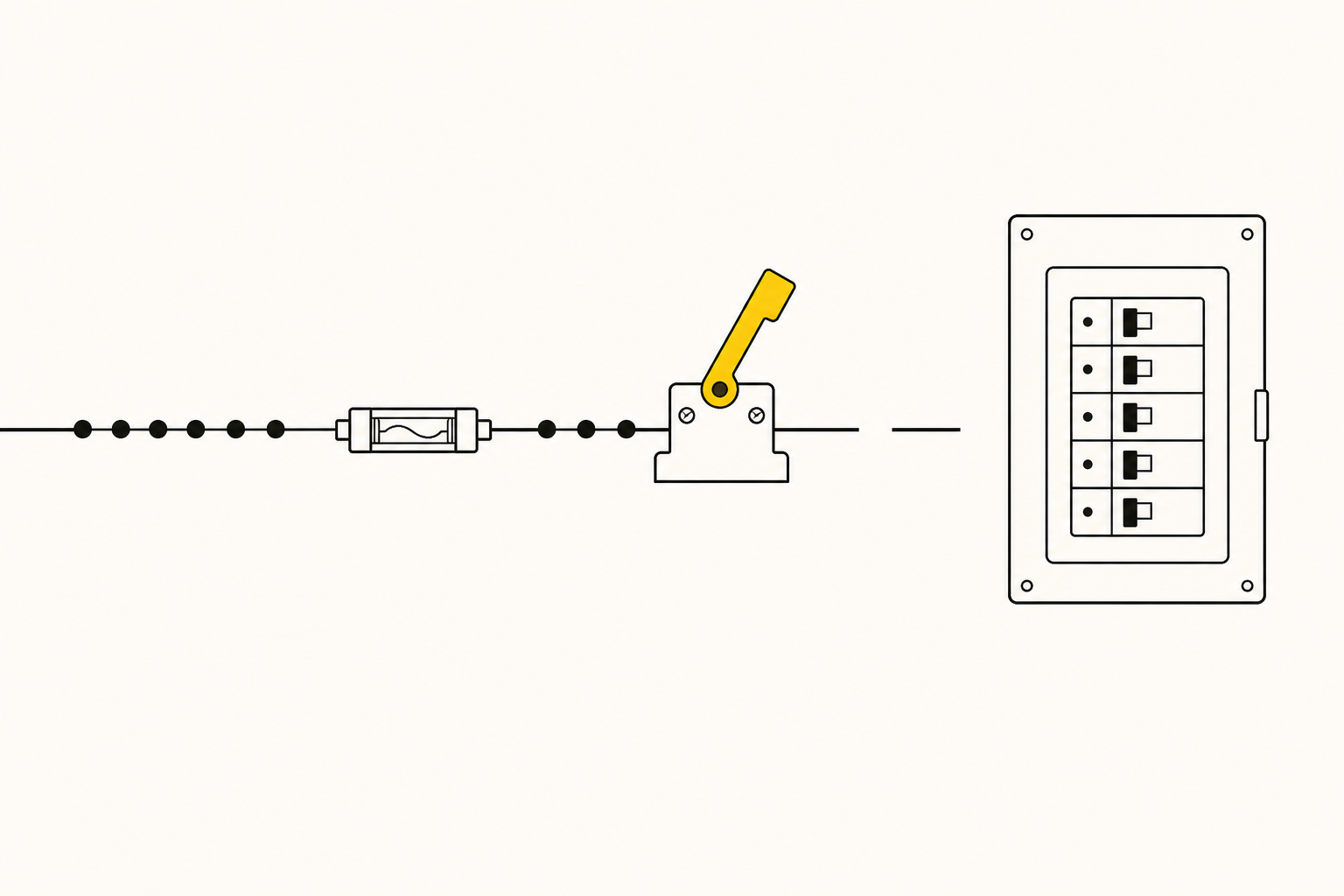
You would never wire a house with unlimited current. Every circuit has a rated amperage, every floor has a fuse, and the main panel has a breaker that will cut everything if the load spikes. We accept this as obvious for electricity, a metered resource that can do real damage when it runs unchecked. Then we take AI agents — which consume a metered resource, tokens, and can do real financial damage when they run unchecked — and plug them straight into the wall with no fuse at all.
That is why runaway AI cost stories keep landing in our inbox. An agent enters a loop and spends five figures overnight. A retry storm hammers an expensive model thousands of times against the same failing call. A slowly growing context balloons every request until each one costs ten times what it should. In almost every case the root cause is not a pricey model. It is missing safety architecture.
Why agent spend spirals
Traditional software has roughly fixed marginal cost per request. Agentic systems do not. Three dynamics turn a normal workload into a runaway:
- Loops. An agent that can call tools and decide its own next step can also decide to keep going. Without a hard stop, a reasoning loop that fails to converge will happily spend until something external stops it.
- Retry storms. A downstream error triggers a retry, the retry fails the same way, and naive retry logic turns one broken call into thousands — each one a paid model invocation.
- Context creep. Every turn appends to the context. Left unbounded, request N carries the weight of requests 1 through N minus 1, and per-call cost climbs quietly until the bill, not the logs, tells you.
The fuse box, mapped to agents
The electrical trade solved this a century ago with a layered safety architecture. The same layers map cleanly onto agent spend.
The fuse: a per-request token limit. The cheapest, most local protection. A single invocation cannot exceed a hard token ceiling, so no one call — however it loops internally — can blow the budget. Like a fuse, it protects the smallest unit of the circuit.
The circuit breaker: a per-workflow budget. One level up, each workflow carries a daily and monthly spend ceiling. Cross it and the workflow trips: new work is paused, not silently served. This is Michael Nygard's circuit-breaker pattern from Release It! applied to money — a breaker that opens when a downstream cost is misbehaving, so a local fault cannot cascade into a systemic one.
The residual-current device: anomaly detection. The sensitive protection that catches the fault a fuse misses. Watch the shape of spend, not just the total: a sudden spike in calls per minute, a retry rate climbing past a threshold, a context length trending toward the ceiling. These are the leak signals that let you trip before the money is gone.
The main panel: one place to see it all. Every home has a single panel where every breaker is visible and reachable. Every AI deployment needs the same — one view of spend across all workflows, with the ability to cut power. Which brings us to the switch that matters most.
The kill switch
A kill switch is a single, deliberate control that halts an agent or a whole workflow immediately, regardless of what it thinks it is doing. It is not an admission of failure; it is the main breaker. The design questions are the ones worth arguing about before you need it:
- Trigger. Automatic on a budget breach or anomaly, manual for a human who sees something wrong, or both.
- Blast radius. Does it stop one workflow, one agent, or everything? You usually want all three scopes available.
- State on stop. Does in-flight work fail safe, roll back, or hold for human review? A fault-tolerant system degrades into a known safe state rather than an undefined one.
Cost control is a business promise, not a dashboard
Most writing on AI cost is about optimization: cheaper models, prompt compression, caching. That is a real discipline — the emerging practice of AI FinOps — and worth doing. But optimization lowers your average bill. It does nothing about the catastrophic tail: the one night an agent spends what it should have spent in a year. Optimization is turning down the thermostat. Safety architecture is the fuse box. You want both, but only one of them lets you promise a CFO that a bad night cannot become a bad quarter.
That promise is the other half of the ROI conversation. ROI tells the CFO what value the workflow creates. Cost architecture tells the CFO what the worst case is bounded to. Deals stall on the second question more often than the first, and "we have a hard cap and a kill switch" closes it in a sentence.
Conclusion
Runaway AI cost is not bad luck and it is not an expensive model. It is a metered, autonomous system wired without protection. Give it a fuse (per-request limits), a breaker (per-workflow budgets), a leak detector (anomaly signals), a panel (unified spend visibility), and a main switch (a tested kill switch), and the disaster scenario stops being possible. Your house has a fuse box. Your agents should too.
References
- Nygard, M. (2018). Release It! Design and Deploy Production-Ready Software (2nd ed.). Pragmatic Bookshelf.
- FinOps Foundation (2024). FinOps for AI: Managing the Cost of Machine Learning and LLM Workloads.
Want budgets, anomaly alerts, and a kill switch on every agent from day one? Book a 30-minute call and we'll show you how it works.